

Email validation is the process of checking that an email address is real, deliverable, and safe to send to, before you send anything. That one sentence hides a lot of machinery: syntax checks, DNS lookups, live conversations with mail servers, and risk scoring for the addresses that pass the technical tests but would still hurt you. This guide explains all of it in plain language. It matters to us because SpamCipher is a cold email platform built for unlimited email sending and automated cold email, and we are the only platform that can promise you 90%+ inbox placement; validation is the first gate that makes the promise possible. Here is what email validation actually is, how it works, and how to use the results.
What is email validation?
Email validation is a series of technical checks that answers one question about every address on your list: if I send a message here, will a real mailbox accept it? A validator takes an address like jane.doe@acme.com and tests it from the outside in. Is it formatted like a legal email address? Does acme.com exist and accept mail? Does the specific mailbox jane.doe exist on that server? And even if it does, is it the kind of address that helps you or the kind that quietly damages you, like a spam trap, a disposable inbox, or a shared role account?
The point of all this is simple. Mailbox providers judge you by the quality of the addresses you send to. Gmail, Outlook, and Yahoo treat a high bounce rate as proof that you do not vet your recipients, and in 2026 the enforced ceiling is blunt: keep hard bounces under 2% and spam complaints under 0.3%, or watch your mail get filtered. Validation is how you know, before the first send, that your list can clear that bar. You will also see the term email verification used for the same thing; the two words are interchangeable in practice, and we use both. If you want the campaign-level view of where this fits, our guide on why verification is step one of every cold email campaign picks up where this explainer ends.
How email validation works, layer by layer
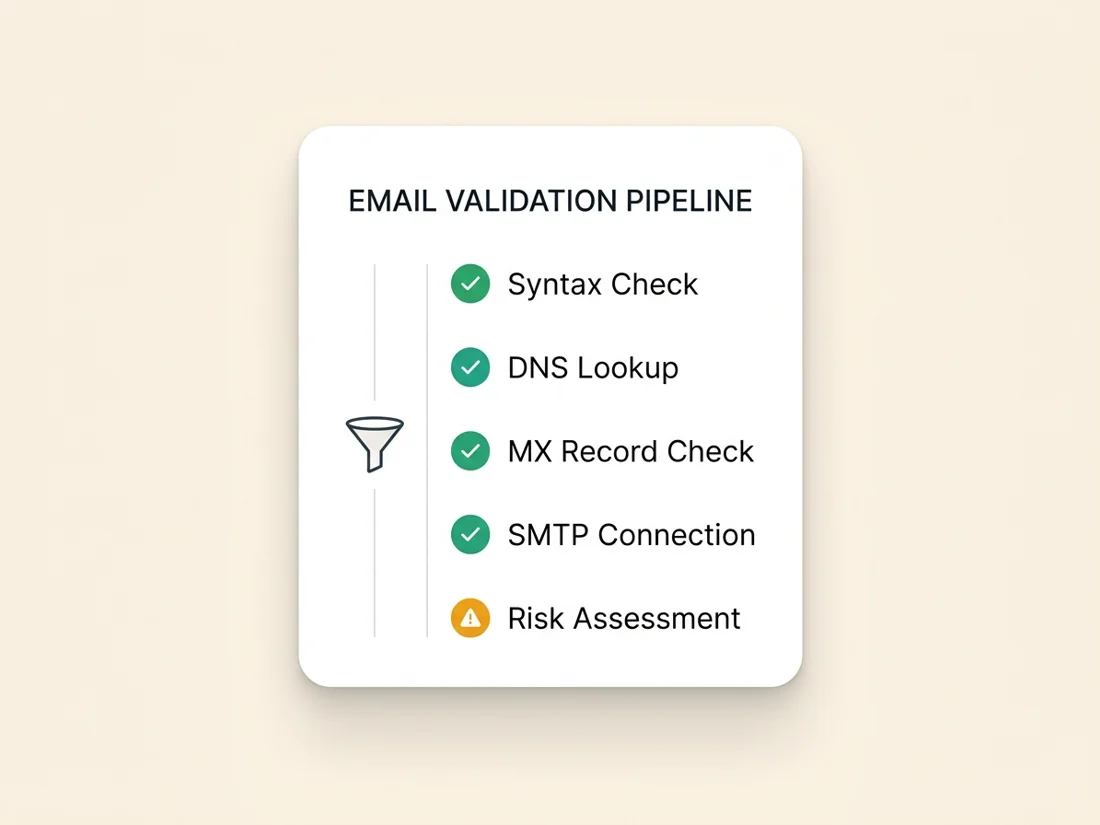
A real validation is layered. Cheap checks run first and knock out the obvious garbage; expensive checks run last and confirm what the cheap ones cannot. SpamCipher's Email Validation runs 19 distinct signals per address, but they group into five layers you can reason about.
- Layer 1: syntax. Is the address structurally legal? This catches typos, stray spaces, missing @ signs, doubled dots, and illegal characters. It is instant and it removes a surprising share of form-fill and scrape errors.
- Layer 2: domain and DNS. Does the domain exist, does it resolve, and is it spelled right? This layer also catches common typo domains like
gmial.comandyaho.comand can suggest the fix instead of just failing the address. - Layer 3: MX records. Does the domain publish mail-exchange records? A domain with no MX is not set up to receive email at all, so every send to it is a guaranteed hard bounce.
- Layer 4: the live SMTP check. This is the heart of validation. The validator opens a real connection to the receiving mail server and asks, in the SMTP protocol itself, whether the specific mailbox exists and will accept mail. No message is ever sent. This is the check that separates real validation from a regex, because only the receiving server knows whether
jane.doeis a live inbox or was deleted two years ago. - Layer 5: risk classification. Some addresses pass every technical check and are still bad news. This layer flags catch-all domains that accept mail for any address, disposable inboxes that self-destruct in minutes, role accounts like info@ and sales@ that go to shared queues, and addresses matching known spam-trap and high-complaint patterns.
The order matters because it makes validation fast and honest at the same time. Syntax failures never waste an SMTP connection, and nothing gets called valid on formatting alone. When a tool advertises validation but only runs layers 1 and 2, it is telling you an address is shaped correctly, not that anyone lives there.
How to read email validation results
Validation does not return a simple yes or no, and that is a feature. A good report sorts your list into result classes, and each class maps to one decision. Here is the standard set and what to do with each.
- Valid. The mailbox exists and accepts mail. This is your sending list. Nothing else should feed a campaign.
- Invalid. Failed syntax, dead domain, no MX, or the server rejected the mailbox. These will bounce. Remove them completely; this class alone is what pushes an unverified list past the 2% ceiling.
- Catch-all (accept-all). The domain accepts mail for every possible address, so the mailbox test cannot confirm the individual inbox. Treat these as risky, not valid. Hold them out of your main send and, if one is genuinely valuable, work it in a small monitored batch.
- Disposable. A temporary address from a burner service. It will be dead within the hour. Remove it.
- Role-based. info@, support@, admin@ and friends. They reach shared inboxes, convert poorly, and complain often. Flag and segment them out of outreach.
- Unknown. The server would not give a definitive answer, often because of aggressive greylisting or a timeout. Retry later rather than assuming either way.
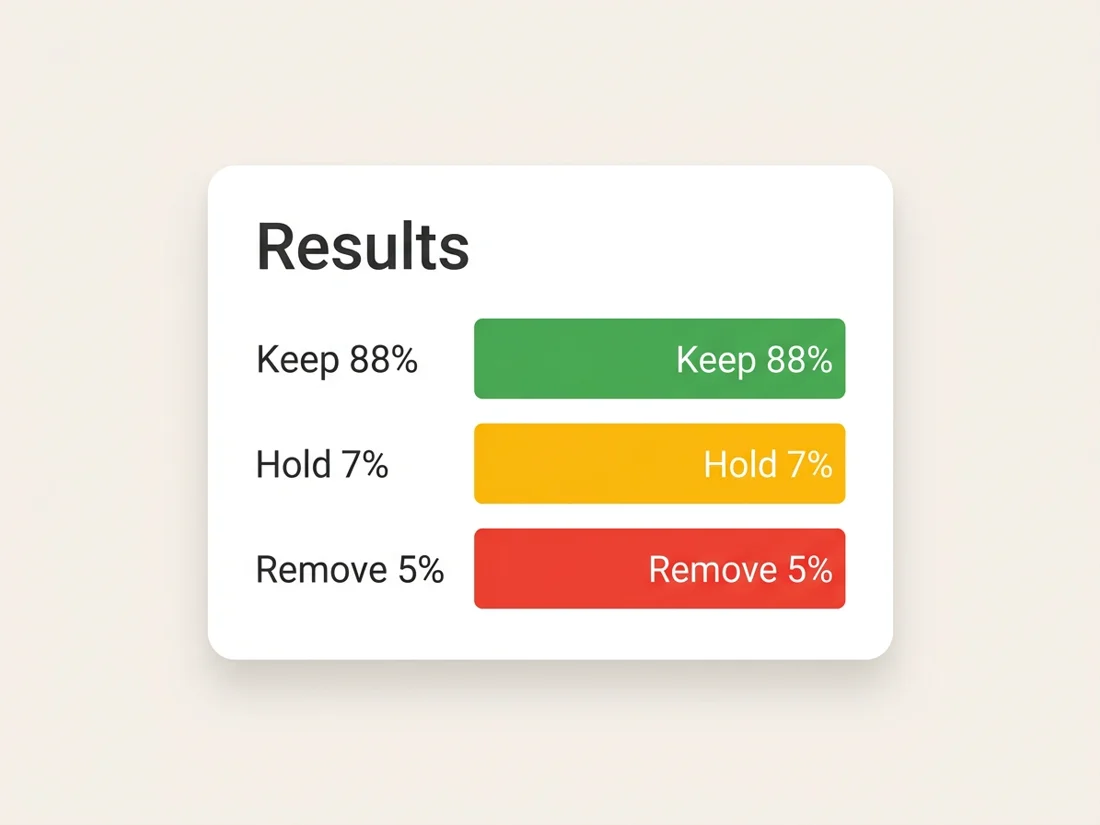
The rule of thumb we give every sender is three words: remove, hold, keep. Remove the invalid and disposable, hold the catch-alls and role accounts and anything trap-flagged, keep the valid. A smaller verified list beats a bloated dirty one every time, because the bloated one is spending your sender reputation on addresses that never existed. Our walkthrough on how to clean your email list the right way covers the judgment calls inside each tier.
Why email validation matters in 2026
Here is the truth: most deliverability problems are list problems wearing a disguise. Senders blame their copy, their ESP, or the weather at Gmail, when the root cause is that a chunk of their list is dead and the providers noticed. Validation matters because it removes that entire failure class before it starts, and the numbers behind it are not subtle.
Email lists decay at roughly 2-3% per month as people change jobs, companies fold, and providers retire abandoned mailboxes. That compounds to a quarter or more of a list going stale within a year, which means a list that tested clean last spring is carrying real bounce risk today. Scraped and purchased lists are worse, routinely arriving with double-digit invalid rates. Send to that unvalidated and three things happen at once: hard bounces spike past the 2% line, so providers start filtering you; recycled addresses that became spam traps fire, so blacklists pick you up; and your metrics turn to noise, because a denominator full of dead addresses makes every open, reply, and placement number a lie.
The damage also compounds in the other direction when you fix it. Validate first and your bounce rate starts under the ceiling instead of over it, your warmed domains spend their volume on humans instead of voids, and every downstream measurement reflects your real audience. Validation is the cheapest lever in email: it costs a fraction of a cent per address and protects assets, your domains and their reputation, that take weeks of warm-up to build and can be torched in one afternoon.
When to validate: bulk, real time, automated
Validation is not a one-time cleanup, it is a habit with three modes, and mature senders run all three.
- Bulk, before every campaign. Run the full list through validation before it touches a sending mailbox. If the list has sat for more than a month, run it again; decay does not wait for your schedule.
- Real time, at the point of capture. Validate addresses as they enter your world, on signup forms, lead forms, and imports, through a validation API. Bad data you never accept is bad data you never have to clean.
- Automated, inside the pipeline. The strongest setup makes validation an enforced gate rather than a remembered chore. In SpamCipher, Email Validation is the front door of the sending pipeline: lists are validated and sorted into remove, hold, and keep before warm-up allocates a single message, and campaigns simply cannot queue unverified addresses. Validation feeds warm-up, warm-up feeds sending, and seed accounts measure where the mail actually lands.
That last mode is the reason we can make promises that a standalone checker cannot. When validation, warm-up, sending, and seed-measured placement run as one owned system, no dirty address ever reaches a mailbox, no bounce ever surprises you, and the placement number on your dashboard is measured, not inferred. That is the architecture behind how we hit 90%+ inbox placement, and it starts with the subject of this article. SpamCipher is the cold email platform for unlimited, automated cold email, the only platform that can promise you 90%+ inbox, and email validation is step one of how the promise gets kept. Validate first, send second, every time.
Validate your list in minutes
Run any list through SpamCipher's 19-point Email Validation, get every address sorted into remove, hold, and keep, and start your next campaign already under the bounce ceiling. It is the first stage of a pipeline built for unlimited, automated cold email and 90%+ inbox placement.
Validate your list free