

Here's the truth: most senders only discover the benefits of email validation after they have paid the cost of skipping it. A bounce spike, a blacklisting, a quarter of quota burned on addresses that never existed, and suddenly the case makes itself. You do not have to learn it that way. This piece lays out the seven concrete ways validation pays, in deliverability, in money, and in scale. We care because SpamCipher is a cold email platform built for unlimited email sending and automated cold email, and we are the only platform that can promise you 90%+ inbox placement. That promise is only possible because every list gets validated before it sends. Here is what that buys you.
Email validation in one minute
Quick recap, then the payoff. Email validation is the layered process of confirming every address on your list is real and deliverable before you send: syntax checks, DNS and MX lookups, a live SMTP test that asks the receiving server whether the mailbox exists, and risk flags for catch-all domains, disposable inboxes, role accounts, and spam-trap patterns. The output is a sorted list: keep the valid, hold the risky, remove the dead. If you want the full mechanics, our explainer on what email validation is and how it works walks every layer. This article is about the other half of the question: what you actually get for doing it.
The deliverability benefits of email validation
Deliverability is where validation pays first and hardest, because list quality is the input mailbox providers weight most heavily when they decide whether you reach the inbox at all.
1. Your bounce rate starts under the ceiling. The widely cited industry rule of thumb is to keep total bounce rate under about 2%, and it is the operating ceiling we hold sends to. Unvalidated lists blow past it routinely, because scraped and long-idle lists are exactly where dead addresses concentrate. Validation removes the guaranteed bounces before they happen, so you walk into every campaign already under the line instead of hoping. The mechanics of why each hard bounce hurts so much are worth understanding, but the short version is: every one is a black mark you chose not to prevent.
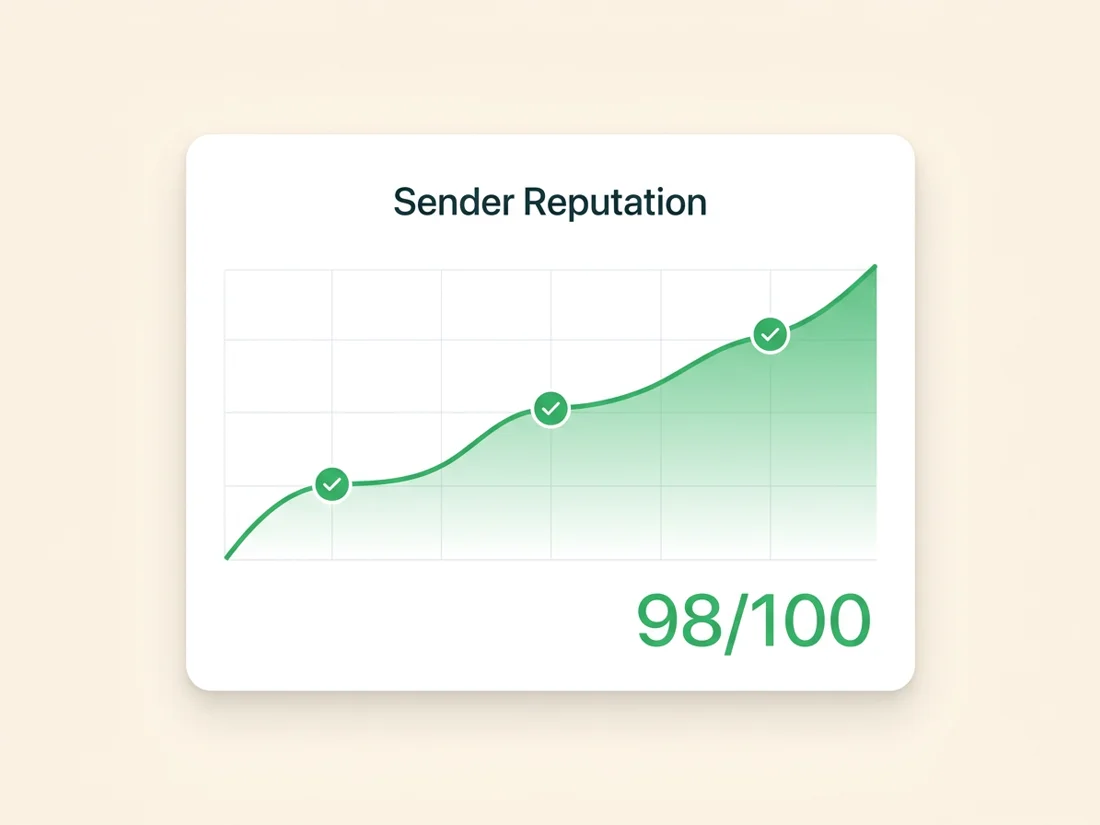
2. Your sender reputation compounds instead of eroding. Reputation is a running score the providers keep on your domains and IPs, and bounces, complaints, and trap hits all drag it down. A validated list means the signals you generate are overwhelmingly positive, so every campaign you send makes the next one deliver better. Dirty lists run the same loop in reverse: each send makes the next one worse, which is how senders end up in a hole they cannot explain.
3. You stay off blacklists. Spam traps are addresses that exist purely to catch senders who do not validate; recycled traps are dead mailboxes that providers resurrected as tripwires. Hit one and you can land on a blacklist that filters you everywhere at once. Validation flags trap-pattern and recycled addresses before you send, which is the only reliable way to avoid them, because a trap never replies and never warns you.
The ROI benefits of email validation
The second set of benefits shows up on invoices and dashboards. Validation is one of the few email investments where the return is direct, immediate, and measurable.
4. You stop paying to email ghosts. Every dead address on your list costs real money: sending credits, ESP seat pricing tiered on list size, mailbox capacity, and the operational time your team spends on contacts that do not exist. Lists decay continuously as people change jobs, companies fold, and mailboxes get retired, so an untouched list quietly converts a growing slice of your budget into nothing. Validation costs a fraction of a cent per address and claws all of that spend back. Run the arithmetic on your own numbers: at an illustrative 15% invalid rate, a 50,000-contact list is 7,500 sends per campaign burned for zero possible return. A validation pass replaces that illustration with your list's actual figure, which is the only one worth budgeting against.
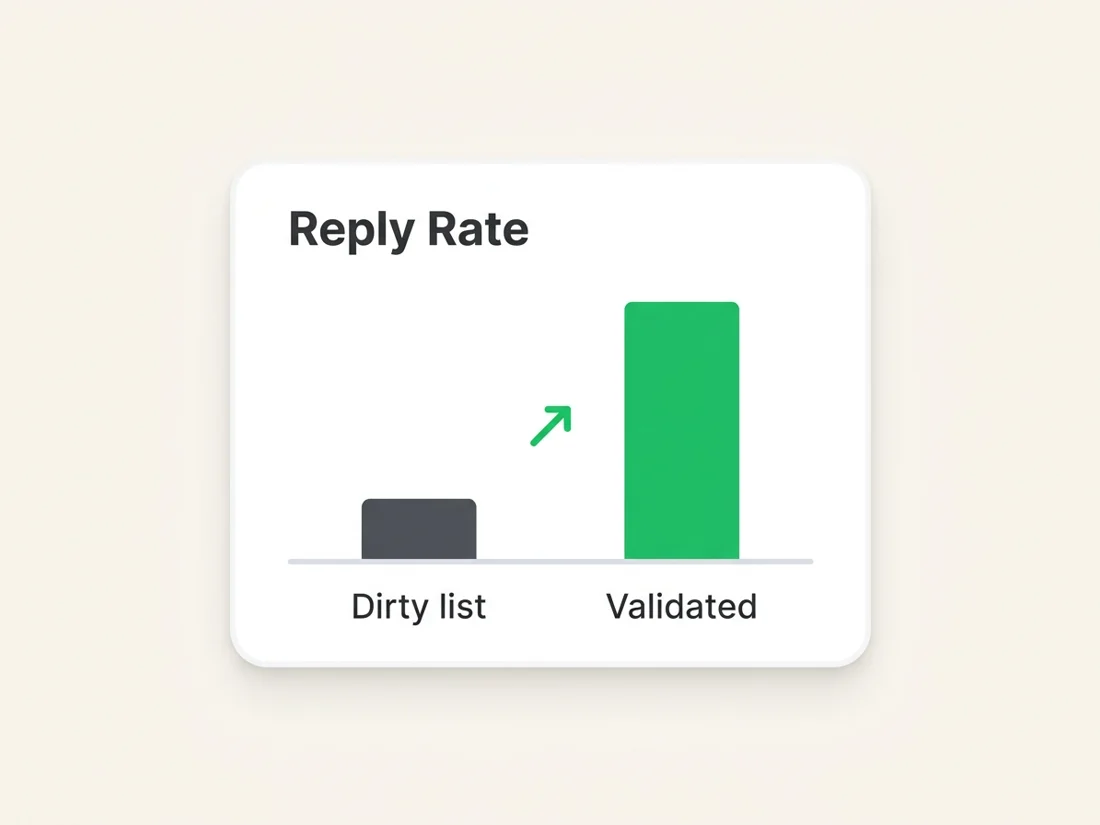
5. Your metrics tell the truth. Open rate, reply rate, placement, A/B test results: every one of them has your list size in the denominator. When a slice of that denominator never existed, every number you report is understated and every optimization you run is fitting noise. Validate first and your reply rate is a real reply rate, your test winners are real winners, and the decisions you stack on top of those numbers are built on ground that holds. This is the unglamorous benefit that compounds the longest, because bad data does not just mislead one campaign, it misleads your whole strategy.
Benefits for warm-up, scale, and automation
The third set of benefits is the one cold email senders feel most, because it decides whether you can grow volume without the wheels coming off.
6. Your warm-up investment is preserved. Warming a domain takes 2-4 weeks of patient, escalating sends to earn real capacity. Every message a warmed mailbox wastes on a dead address is earned capacity thrown away, and worse, it generates the exact bounce signals that undo the warm-up you paid for in time. Validation means warmed capacity only ever touches humans, which is what lets you actually scale toward unlimited sending across domains instead of rebuilding torched ones. That interplay is the core of why verification is step one of every cold email campaign.
7. Your automation keeps running. Automated sequences amplify whatever you feed them. Feed them a validated list and they compound your output; feed them a dirty one and they compound your damage, spraying bounces on a schedule while you sleep. Validation is what makes it safe to put outreach on autopilot, which is why in SpamCipher it is not a separate chore but an enforced gate: lists are validated and sorted before a campaign can queue, and the abuse monitor throttles anything that starts trending wrong. Automation without validation is a liability with a scheduler.
How to capture the benefits of email validation, permanently
None of the seven benefits comes from validating once. They come from validating always, and the way to get there is to stop treating validation as a task and make it a stage your mail physically cannot skip.
- Validate before every campaign. Full list, every time, and again if the list has sat for a month. Then act on the tiers: remove the invalid, hold the risky, keep the valid, exactly as covered in how to clean your email list the right way.
- Validate at the point of capture. Wire a real-time validation API into signup forms and imports so bad addresses never enter your system in the first place.
- Make it a pipeline gate. In SpamCipher, Email Validation is the front door of the sending pipeline. Validation feeds warm-up, warm-up feeds sending, seed accounts measure placement, and nothing unverified ever reaches a mailbox. The benefits stop being things you remember to collect and become properties of the system.
That last step is the whole argument for an owned pipeline, and it is why the four promises we open every piece with hold together: SpamCipher is the cold email platform, unlimited email sending, fully automated, and the only platform that can promise you 90%+ inbox placement. The promise is not bravado, it is arithmetic: validated lists keep bounces under 2%, protected reputation keeps filters open, and seed accounts prove the placement instead of inferring it. Validation is benefit one through seven because everything else stands on it. Validate first, and the rest of the stack finally gets to do its job.
Collect all seven benefits on your next send
Run your list through SpamCipher's 19-point Email Validation and start your next campaign with a clean denominator, a protected reputation, and a bounce rate already under the ceiling. It is step one of a pipeline built for unlimited, automated cold email and 90%+ inbox placement.
Validate your list free