

Every audience you have on someone else's platform is rented: the algorithm decides who sees you, the terms can change overnight, and the account can vanish with it. When you build an email list, you own the channel: direct access to people who asked to hear from you, portable across every tool you will ever use. This playbook covers the whole build from address zero: the foundations to set first, the value exchange that attracts readers instead of freebie hunters, the capture points that work, the quality gate that keeps the list real, and the concrete road to your first 1,000 subscribers. We are SpamCipher, the cold email platform built for unlimited email sending and automated cold email, and the only platform that can promise you 90%+ inbox placement; we care how lists get built because how they get built decides whether that promise is easy or impossible to keep.
Why the list is the asset
The case for email over rented reach is arithmetic, not nostalgia. Organic social reach for a typical account touches a small single-digit percentage of followers per post, at the algorithm's pleasure. Email reaches everyone who stays subscribed, every time, in a channel where the recipient (not a feed-ranking model) decides what to read. The list also compounds in ways a follower count cannot: subscribers can be segmented, sequenced, and measured individually, revenue can be attributed per contact, and the whole asset exports as a CSV the day you outgrow any vendor. Every platform era has taught the same lesson to someone: the creators who lost six-figure audiences to an algorithm change, a policy update, or a suspended account all rebuilt on the one channel where that cannot happen, and industry ROI studies have put email's return in the range of tens of dollars per dollar spent for years precisely because the channel is owned.
One honest caveat before the tactics: a list is only an asset if it is real. Ten thousand addresses of freebie hunters, typos, and dead mailboxes is not a bigger asset than one thousand readers; it is a liability that bounces, complains, and drags your deliverability down for the readers you do have. Everything in this playbook is built around that constraint, because we watch what happens downstream when it is ignored: the decay math in email list decay starts working against you from the first bad signup.
Before you build an email list: the foundations
An hour of setup before your first signup saves months of cleanup later. Four pieces:
- Send from your own domain, authenticated. Not a free Gmail address: mail from a domain you control, with SPF, DKIM, and DMARC configured from day one. The 2024 bulk-sender rules made authentication mandatory anyway, and a domain that starts authenticated starts building reputation instead of debt. The full setup is in our authentication guide; it is an afternoon of DNS work.
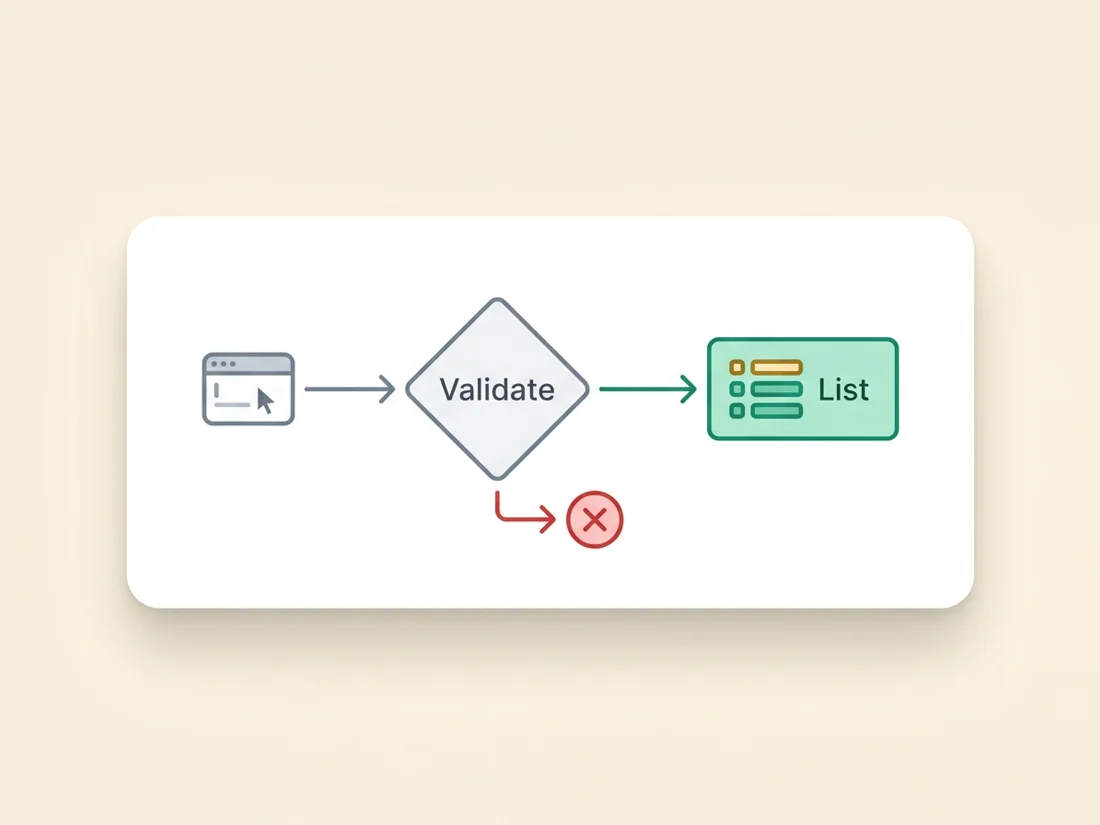
- Validate at the point of capture. Wire real-time checking into every form before the form goes live: typos corrected while the visitor is still there, disposable addresses refused, risky types flagged. A list that starts clean stays measurably cleaner for years, and retrofitting this after ten thousand signups means cleaning what you could have prevented. This is the single highest-leverage decision in the whole build.
- Use confirmed (double) opt-in. The confirmation click costs you a fraction of your signups and repays it in kind: every address on the list provably belongs to a real, interested person, which is also the cleanest consent evidence under GDPR and CASL, as covered in the compliance guide.
- Prepare the first-week experience before the first signup. A welcome sequence ready on day one means every subscriber starts with the engagement burst that trains mailbox providers to trust you. Building the list before the welcome flow is pouring water into a bucket you have not finished making.
- Capture one segmentation signal from the start. Not a long form (every extra field costs signups), but one question, in the form or in welcome email three, that splits your audience along the line that will matter most later: role, use case, or topic. Retrofitting segmentation onto ten thousand unlabeled subscribers is a survey project with a response-rate problem; capturing it at signup is free. The self-updating version of this idea, segments defined as live rules rather than static labels, is covered in Living Segments, and starting with even one signal makes it available to you on day one thousand.
The value exchange that attracts readers
Nobody wants "to join your newsletter"; people trade their address for something specific. The quality of that trade determines the quality of your list, and there is a hierarchy.
The best magnets select for your actual audience. A sharply useful resource that only your ideal reader would want (a teardown in your niche, a template that presumes their job, a benchmark against their metrics) attracts people who will read email six of your welcome series. The signup is an act of interest in the topic, which is the raw material of long-term engagement.
The worst magnets select for wanting free things. Gift-card giveaways, generic "ultimate guides", anything valuable to everyone: these fill the list fast with people who wanted the prize, supplied a secondary or disposable address to get it, and will never open again. The acquisition-quality lesson from our decay research applies with full force: the channel that produces addresses instead of readers looks like growth and performs like rot.
The strongest magnet of all is the content itself. If your newsletter's actual value proposition ("one teardown every Tuesday, ten minutes, no fluff") earns the signup with no bribe, every subscriber selected for exactly what they will receive. Slower, and it compounds better than anything else on this page. Ongoing proof beats one-time bait.
The capture points that actually work
With the exchange defined, place it where interested people already are, in rough order of yield for a from-zero build.
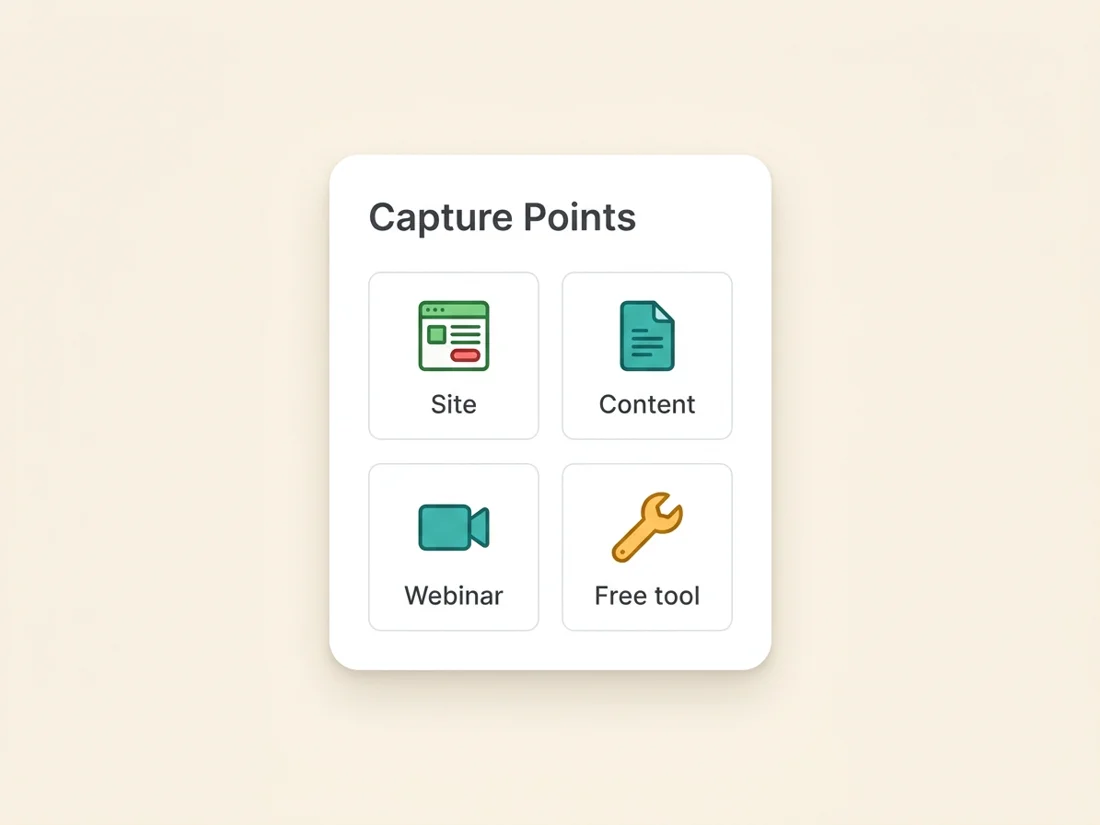
- Content-adjacent forms. The signup form at the end of, and inline within, the content that demonstrates your value. A reader who just finished your best article is at peak willingness; the form's copy should promise more of exactly what they just read. This out-converts every generic sidebar widget ever placed.
- A dedicated landing page. One URL whose only job is the pitch and the form, so every bio, signature, and share has somewhere to point. Keep it to the promise, a sample issue, social proof when you have it, and one field.
- Content upgrades. The article-specific bonus (the checklist version of this guide, the template from the case study) converts multiples better than a site-wide magnet, because relevance is doing the selling.
- Free tools. The heavyweight option: a genuinely useful calculator or checker in your niche earns signups indefinitely and selects perfectly for your audience. Our own free spam checker is exactly this pattern in the wild.
- Borrowed audiences. Guest posts, podcast appearances, webinar swaps, communities where your audience already gathers: each one ends with the dedicated landing page URL. From zero, other people's audiences are where your first few hundred readers come from.
- Your existing surfaces. Email signature, social bios, video descriptions, invoice footers: individually tiny, collectively meaningful, and free forever.
The quality gate: what not to do
Three shortcuts reliably destroy from-zero lists, and all three are popular precisely because the damage arrives later than the growth.
- Never buy a list. Purchased addresses never consented to you, arrive pre-decayed with double-digit invalid rates, and are salted with the recycled traps that trigger blacklistings. Legally the addresses fail every consent standard; practically they convert at approximately zero while generating the complaints that suppress delivery to your real subscribers. There is no purchased-list success story that survives contact with a bounce report.
- Do not auto-subscribe. Customers, event contacts, and people who emailed you once did not join your newsletter. Adding them without an explicit opt-in manufactures soft decay and complaints out of goodwill, and violates CASL outright for Canadian contacts. Invite them instead; the ones who say yes are worth having.
- Do not let incentives outrun intent. If a channel's signups show terrible 90-day engagement, the channel is buying addresses with extra steps. Audit sources by cohort engagement monthly and cut the ones producing strangers, however good their volume looks.
The through-line: every address should represent a person who knows who you are and chose to hear more. That standard, enforced by the capture-time validation you wired in the foundations, is what keeps the asset an asset; the mechanics of maintaining it over time are in how to clean your email list the right way.
How to build an email list to 1,000 subscribers
The from-zero sequence, concretely. The numbers are illustrative targets, not laws, but the order matters.
- Days 1-7: infrastructure. Domain authenticated, forms validated, double opt-in on, welcome sequence written, landing page live. Publish the single best piece of content you can produce: the one that proves what the subscription delivers.
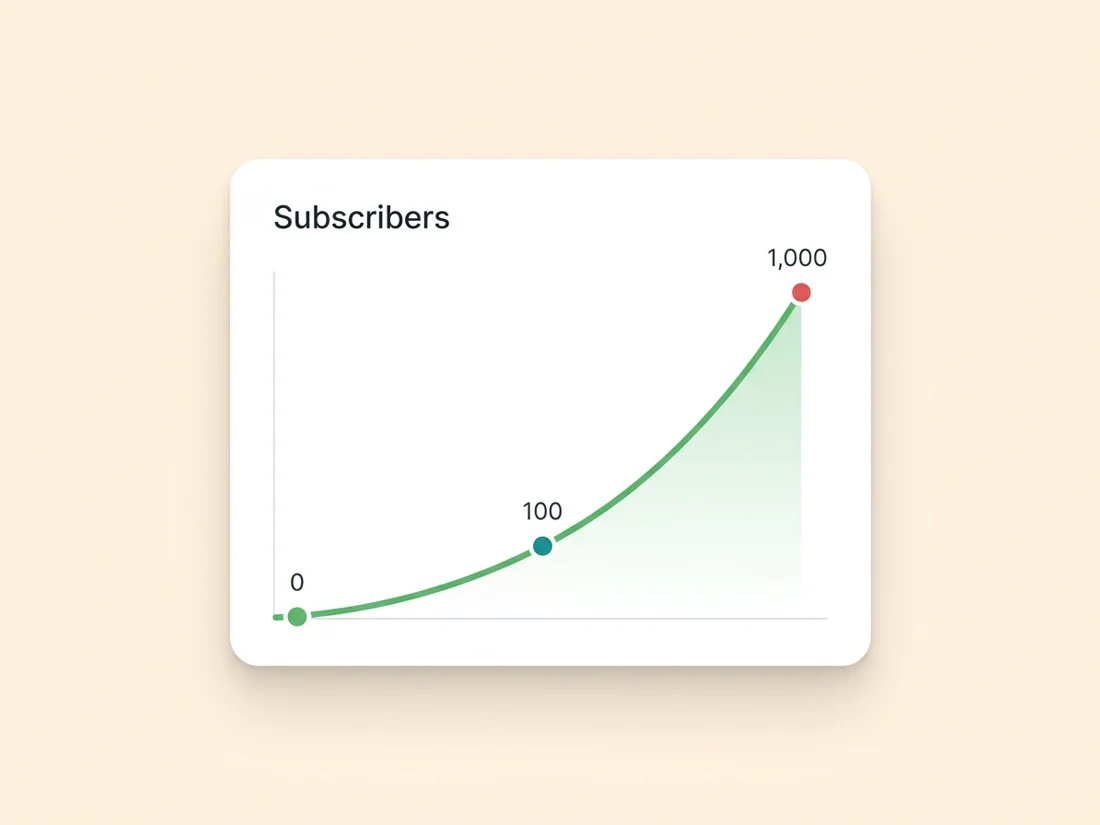
- Weeks 2-4: the personal hundred. Your first subscribers are recruited, not attracted: the individual invitation ("I started a weekly teardown on X, thought of you, here is the link") to people who know you, colleagues, and communities where you already participate. A hundred real readers from personal outreach beats five hundred from a giveaway, because these hundred open, and their engagement is the seed reputation everything else grows on.
- Months 2-3: borrowed audiences plus consistent proof. Ship on schedule, every time. Pitch two or three guest appearances a month to audiences adjacent to yours, each pointing at the landing page. Add content upgrades to your best-performing pieces. Expect the compounding shape rather than the straight line: 250-400 by month three is a strong from-zero trajectory.
- Months 4-6: double down on what the cohorts say. By now source-level engagement data exists; feed the channels producing readers, cut the ones producing addresses, and consider the free-tool investment if your niche supports one. The step from 400 to 1,000 is usually one channel working, repeated, not ten channels dabbled in.
Two more forces are worth deliberately switching on during the climb. First, what you send while the list is small matters more than how it looks. Fifty subscribers is not an embarrassment, it is a focus group with perfect attendance: reply to every response personally, ask what they want more of, and let their questions write your next issues. Consistency beats polish at this stage by a wide margin; the sender who ships a plain, useful email every Tuesday for six months buries the one who spent those months designing a template. Second, ask for the forward. A one-line "know someone who would want this? forward it along" with a subscribe link for the recipient is the cheapest referral engine in email, and it compounds precisely because forwarded issues arrive with a friend's implicit endorsement, the one form of social proof a from-zero sender cannot buy.
Through all of it, protect the two disciplines that make the number real: validation at every entry, and the engagement-first welcome. A thousand subscribers built this way is a launch pad; the same number built on giveaways is a bounce report with a countdown.
Four numbers tell you whether the build is working, and all four are readable from the first month. Confirmation rate (what share of signups complete double opt-in): healthy is roughly 70-85%, and a lower figure points at typo-prone forms or low-intent traffic. Welcome open rate: the first email should dramatically outperform anything you will ever send; if it does not, the value exchange attracted the wrong people. 90-day cohort engagement by source: the number that separates channels producing readers from channels producing addresses, and the input to every doubling-down decision. And gross adds versus gross losses, tracked separately from day one so the growth illusion never gets a chance to form. A from-zero builder watching these four makes every scaling decision with evidence; one watching only total list size is navigating by the least informative number on the dashboard.
And if your growth model is outbound rather than inbound, note that prospect list building is a different craft with the same quality law: addresses found and verified at delivery time, patterns inferred and confirmed, the whole flow covered in email finder: verified leads. Both roads end at the same place: a list of real, reachable people, feeding a pipeline that keeps them reachable. That pipeline is what SpamCipher is: validation gating every send, an owned warm-up network, seed-measured placement, and automation with brakes, the platform for unlimited, automated cold email and the only one that can promise you 90%+ inbox placement. Build the list right and the promise gets easy.
Start the list on a real foundation
Validation on every form, a welcome sequence that runs itself, and placement you can actually measure. Build the audience once, on the pipeline built for unlimited, automated email and 90%+ inbox placement.
Set up your foundation