

Your email list is dying at a predictable rate, and it does not care how carefully you built it. Email list decay quietly retires roughly 2-3% of addresses every month as people change jobs, companies fold, and inboxes get abandoned, which compounds to a quarter or more of your list going bad within a year. Left alone, decay converts your best-performing asset into a bounce generator; understood, it is one of the most manageable problems in email. We are SpamCipher, the cold email platform built for unlimited email sending and automated cold email, and the only platform that can promise you 90%+ inbox placement; that promise survives contact with reality precisely because our pipeline treats decay as a permanent condition to be managed, not a one-time cleanup. Here is the full picture: the math, the causes, the symptoms, and the two-sided defense.
What is email list decay?
Email list decay is the continuous loss of usable addresses from a list through no fault of your sending: mailboxes die, people move on, and interest fades, whether or not you touch the list at all. It is a property of the world, not of your program, which is why a list that sits untouched in your CRM decays at nearly the same rate as one you mail weekly. The only difference is that the mailed list shows you the damage in bounce reports while the idle one saves it up for an ugly surprise.
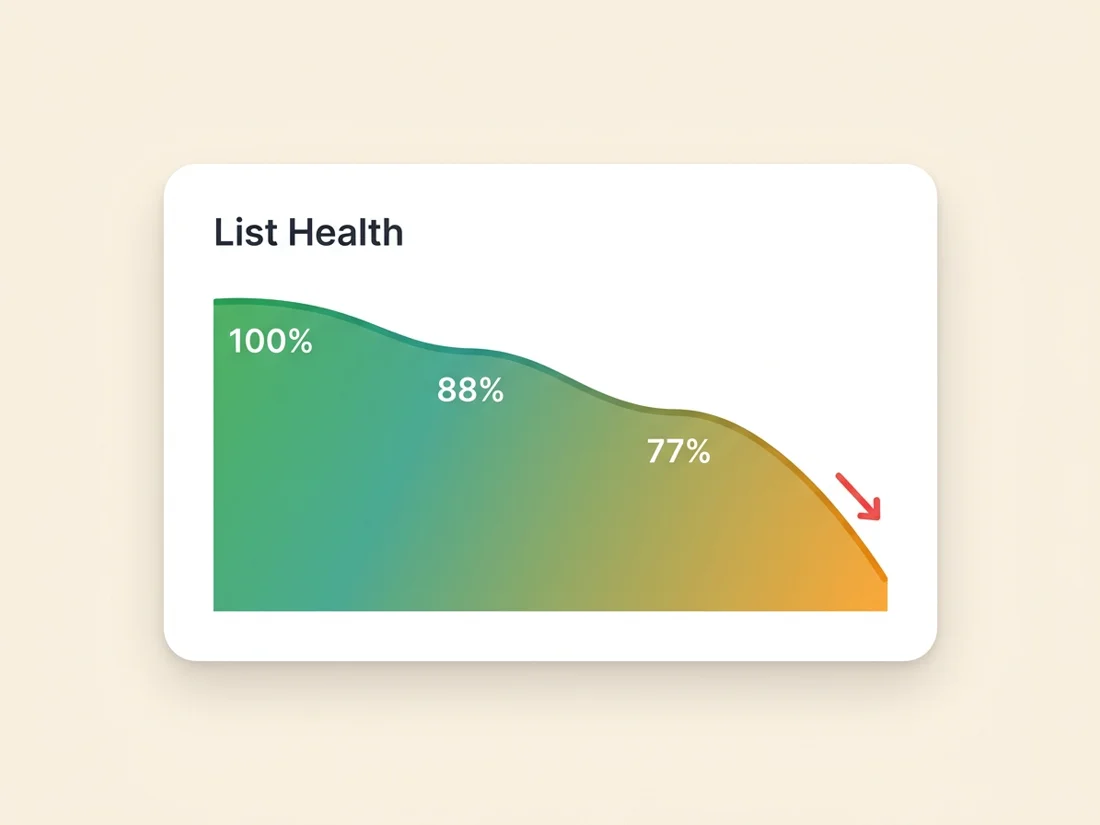
The compounding math is what makes decay dangerous, because monthly rates sound small. At a conservative 2% monthly loss, 100% of a list becomes roughly 89% in six months and 78% in a year. At 3%, a B2B rate we see routinely, the year-end figure is closer to 69%. Now add the second-order effect: the addresses that die are disproportionately the older ones, which are also the contacts your revenue attribution says are most valuable, so the decayed slice is not a random sample, it is weighted toward your history. A two-year-old list that has never been re-validated is not a smaller version of what you built; it is a different, worse list wearing the same name.
Hard decay and soft decay: two different diseases
Decay comes in two forms that need different treatment, and conflating them is why so many cleanup projects disappoint.
Hard decay is the address itself dying: the mailbox is deleted, the domain lapses, the company shuts down. Hard decay produces hard bounces, threatens the 2% ceiling providers enforce, and can eventually produce something worse: providers and blocklist operators recycle long-dead addresses into spam traps, so a sufficiently stale list contains addresses that actively punish you for mailing them. Hard decay is a data problem, and the cure is validation: the dead are detectable from outside, so detect and remove them before sending.
Soft decay is the person disengaging while the address stays alive: they stopped opening six months ago, your mail goes straight to their archive, and one bad day the accumulated indifference becomes a spam complaint. Soft decay never bounces, which makes it invisible to validation, and it does its damage through the engagement signals mailbox providers weight heavily: a list full of silent recipients tells Gmail your mail is ignorable, and Gmail believes it for everyone else on the list too. Soft decay is a relationship problem, and the cure is behavioral: measure recency, attempt re-engagement, and sunset the unrecoverable.
One list, two diseases, two treatment tracks. Every recommendation later in this piece belongs to one track or the other, and running only one track (usually validation, because it is easier to buy) leaves the other disease untreated.
To make the lifecycle concrete, follow one address through it. Jane at Acme signs up in January; the mailbox is valid and she reads you weekly. In August she changes jobs: her mailbox enters limbo, perhaps forwarding for a quarter, perhaps swallowed silently by Acme's catch-all. By the following spring the mailbox is deleted and your sends hard-bounce. If you keep mailing through the bounces, sometime later the address may complete the dark final act: revived by a blocklist operator as a recycled trap, where one more send from you becomes a blacklist entry. Every stage of that timeline was detectable (falling engagement, then a catch-all flag, then hard bounces), and every stage gave a well-run cadence a chance to exit gracefully. Decay only becomes a catastrophe for senders who ignore all four warnings in a row.
Decay also runs at different speeds by list source, which should set your re-validation schedule. Organically grown, double-opt-in lists decay slowest: the addresses were real and personally owned on day one. Event and lead-magnet lists decay faster, salted as they are with typos, throwaways, and one-time interest. Purchased and scraped lists are the extreme case: they arrive pre-decayed, since the data was collected over years and never maintained, which is why a "fresh" purchased list routinely fails validation at double-digit rates on delivery day. Rank your segments by source and give the fast-decaying ones the short leash.
Where the churn comes from
Knowing the sources tells you which lists rot fastest and where prevention actually applies.
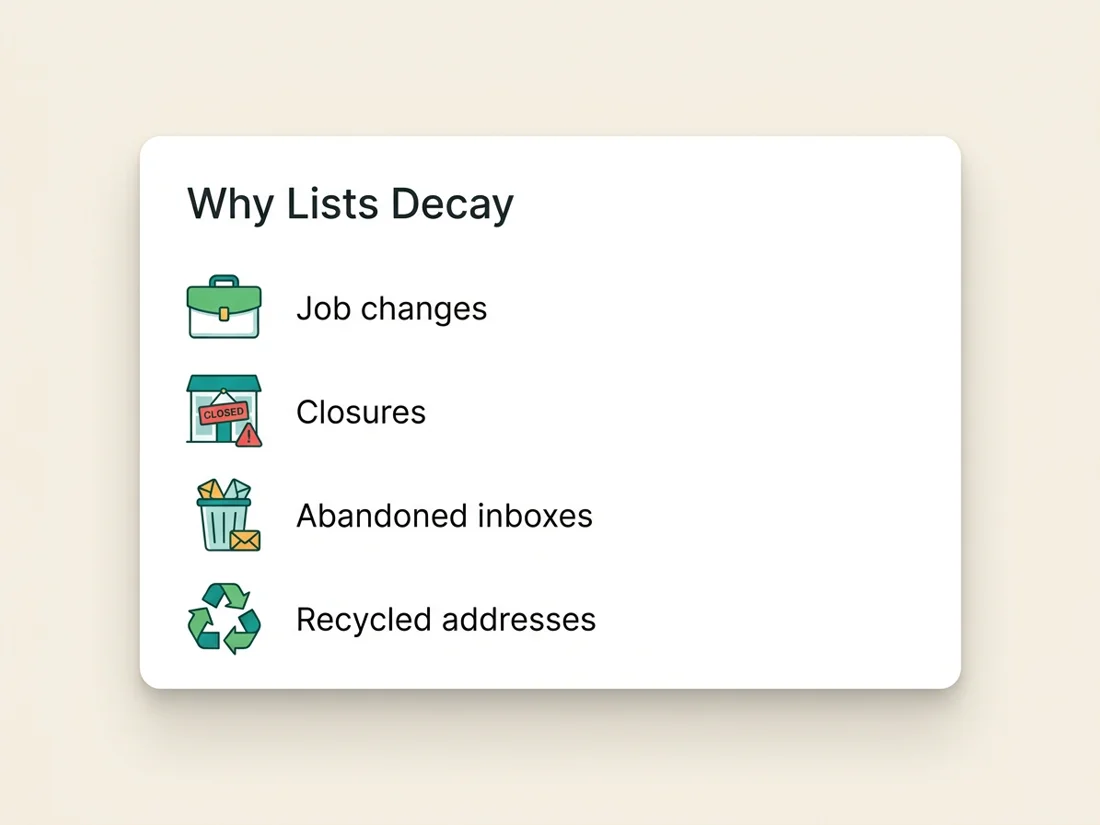
- Job changes. The dominant force in B2B. Every departure kills a corporate mailbox (or worse, leaves it as a silent catch-all bucket), and turnover in many industries runs high enough to explain most of the 2-3% monthly rate on its own. Sales-heavy and tech-heavy audiences churn fastest.
- Company closures and consolidations. A failed or acquired company can take every address on its domain to zero overnight; a rebrand quietly strands the old domain's mailboxes behind forwarding rules that eventually lapse.
- Abandoned personal inboxes. Consumers rotate providers and let old accounts rot; providers eventually deactivate dormant mailboxes. That secondary Gmail someone used for signups in 2022 may accept mail long after anyone reads it, contributing soft decay first and hard decay later.
- Recycled addresses. Providers re-issue deactivated addresses to new users, and blocklist operators convert some into recycled spam traps. Both outcomes are hostile to you: the new owner never opted in and complains, and the trap simply reports you.
- Preference drift. The soft-decay engine: the problem your content solved got solved, the role changed, the interest moved on. Nothing in the data changes except the behavior.
The symptoms of email list decay
Decay announces itself in your metrics long before it becomes a crisis, if you know which movements to read.
- Bounce rate creeping upward across sends with no change in list source. Each campaign clears out some dead addresses and the decay replaces them; when the replacement rate wins, the trend line points up, and the 2% ceiling approaches. A sudden spike is a different problem with its own playbook (covered here); decay is the slow version.
- Engagement sliding while content holds steady. If open and click rates decline a point or two per quarter and nothing else changed, the audience is decaying underneath the content. Teams burn quarters A/B testing subject lines against an audience that is simply evaporating.
- Revenue per send falling. The commercial version of the same signal: the list number on the dashboard holds steady while the money each send produces shrinks, because the denominator quietly fills with ghosts.
- The growth illusion. The most deceptive symptom: your list "grows" 1% a month because acquisition adds 3.5% while decay removes 2.5%, meaning the list that looks stable is actually turning over almost a third of itself annually. Track gross adds and gross losses separately or the netting hides the churn entirely.
- Blocklist and trap incidents. The late-stage symptom: a list that has decayed long enough accumulates recycled traps, and the first blocklist entry is often the moment a team discovers years of unmanaged decay at once. By this stage the cheap fixes are gone; delisting takes weeks and the reputation damage lingers longer.
There is also a straightforward economic reading of these symptoms, worth running on your own numbers. Take a 50,000-contact list that has decayed 20% without maintenance: 10,000 addresses now contribute nothing. If your ESP prices by list size, you are paying storage and send costs on ghosts; if each campaign historically produced, say, two dollars per genuine contact per year, the decayed slice is silently deleting five figures of annual expected revenue while the dashboard says nothing changed. Meanwhile the bounces and dead engagement from that slice suppress deliverability to the 40,000 real contacts, taxing the revenue they would have produced too. Validation for the same list costs a few hundred dollars. Decay management is not hygiene for its own sake; it is one of the highest-ROI line items in the whole email budget.
Prevention: slow the decay at the source
You cannot stop people changing jobs, but you can stop decay from entering the list and slow the soft kind considerably.
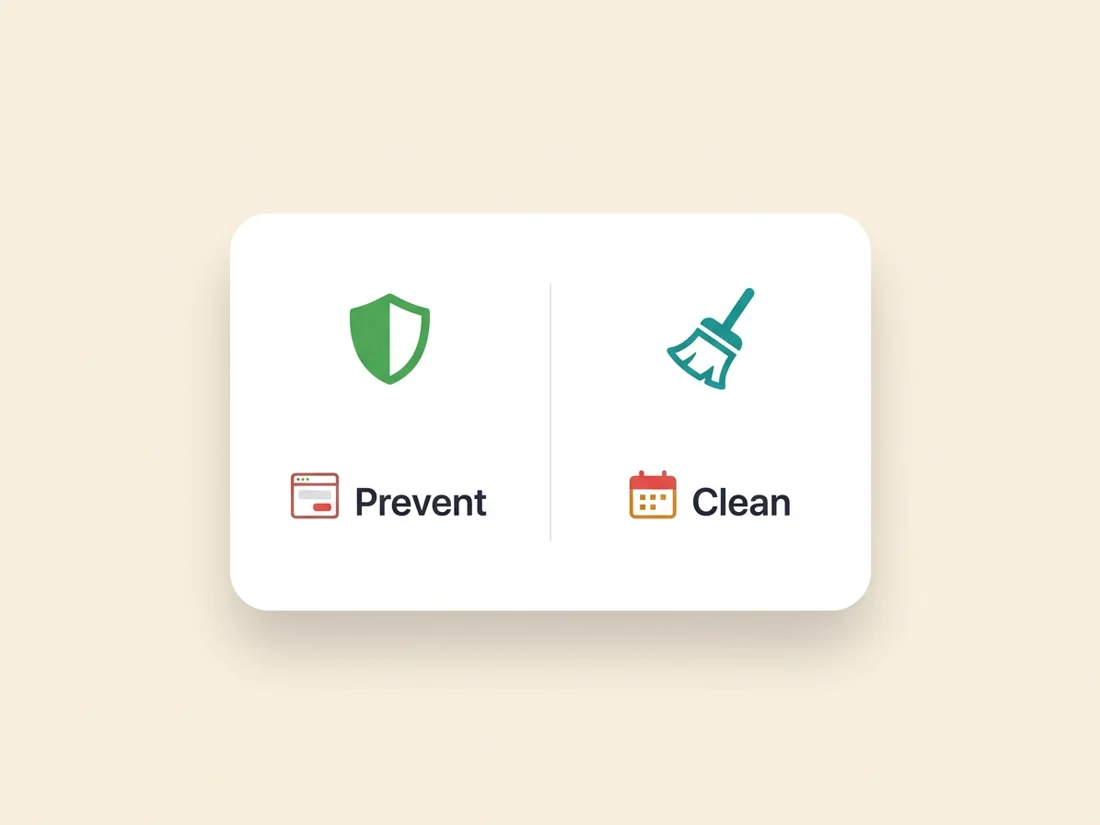
- Validate at capture. Real-time checking on every form and import (typo correction, disposable blocking, risk flagging) means the list starts clean, which resets the decay clock at its youngest possible point. This is the "prevent" half of the system and it costs nothing to run once wired: the real-time validation API is exactly this.
- Win the first week. A strong welcome sequence converts a new signup into an engaged reader while attention is at its lifetime peak. Engagement earned early is the best soft-decay vaccine, because providers and people both build habits from first impressions.
- Keep the promised cadence. Erratic sending accelerates soft decay: audiences forget senders who disappear for two months, and the return email lands as a stranger's. Consistent, expected frequency keeps the relationship, and the engagement signals, alive.
- Offer a downshift before the exit. A preference option ("monthly digest instead?") retains readers whose interest cooled but did not die, converting would-be soft decay into a lighter but live relationship.
The deepest prevention lever sits one step before any of these: acquisition quality sets the decay rate you inherit. Addresses collected through heavily incentivized mechanics (giveaway entries, gated freebies with no relation to what you sell, purchased "opt-in" data) decay fastest on both tracks, because the person wanted the prize rather than the relationship, and a meaningful share supplied throwaway or secondary addresses to get it. Addresses earned through content and product interest decay slowest, because the signup itself was an act of genuine attention. When you see a segment with chronic soft decay, the fix is usually upstream in how those contacts were acquired, not downstream in subject-line optimization. Audit acquisition sources against 90-day engagement by cohort, keep the channels that produce readers, and let the channels that produce addresses die; a slower-growing list of real interest compounds past a fast-growing list of strangers within a few quarters.
The cleanup cadence
Prevention slows decay; nothing stops it. The other half of the system is a standing cadence that finds and handles the loss on schedule instead of by surprise.
- Re-validate on a clock. Full-list validation quarterly for active lists, plus always before any major send and before mailing anything that sat idle for a month. Apply the standard policy to results (remove invalid and disposable, hold risky), exactly as laid out in how to clean your email list the right way. This clears hard decay before it reaches your bounce rate.
- Run a recency ladder for soft decay. Segment by last engagement: 0-90 days is your live list; 90-180 gets a re-engagement attempt with your best material; past 180 with no response gets a final "should we stop?" message and then a sunset. Removing the silent feels like shrinking the business; it is actually deleting the fiction, and every engagement metric and placement score improves when the denominator tells the truth.
- Measure gross, not net. Report adds and losses as separate numbers monthly. The single "list size" metric is where decay hides; the two-number version is where it gets managed.
- Make the cadence structural. The reason decay defeats most teams is that every step above depends on someone remembering. The durable version builds the checks into the sending path: in SpamCipher, validation gates every campaign automatically, engagement recency feeds segments that update themselves, and the abuse monitor brakes if a decayed segment ever slips through and starts bouncing. Decay keeps happening, and the system keeps absorbing it, which is the only arrangement that survives contact with a busy quarter.
That structural answer is the thread running through everything we build, and it is why the four promises hold: SpamCipher is the cold email platform, unlimited email sending, automated cold email, and the only platform that can promise you 90%+ inbox placement, because the pipeline treats list decay as weather rather than as a surprise. The list you have today is the best it will ever be without maintenance. Build the prevent-and-clean system once, and the 2-3% monthly tax stops compounding against you; the full payoff list follows from there.
Stop the decay tax
Validate at capture, re-validate on a cadence, and let self-updating segments retire the silent automatically. A list that stays real, feeding a pipeline built for unlimited, automated cold email and 90%+ measured inbox placement.
Check your list's health