

Here's the truth about email automation: it does not fix a data problem, it schedules one. A sequence engine sends whatever you feed it, at scale, on time, while you sleep, and it does not know the difference between a verified decision-maker and an address that died two years ago. Feed it a dirty list and you have built a machine that sprays bounces and broken personalization around the clock. SpamCipher is a cold email platform built for unlimited email sending and automated cold email, and we are the only platform that can promise you 90%+ inbox placement, and the reason our automation can make that promise is that it refuses to run on dirty data in the first place. Here is exactly how bad data breaks automation, and the stack that makes autopilot safe.
Email automation amplifies whatever you feed it
Manual sending has a safety feature nobody appreciates until it is gone: a human looks at every send. You notice the weird address, the missing first name, the company that does not exist, and you skip it. Automation removes the human, which is the entire point, and with it every one of those quiet saves. The sequence fires on schedule whether the data deserves it or not.
That makes automation a multiplier on data quality in both directions. Clean data in, and every good property compounds: consistent follow-ups, honest metrics, sequences that branch on real behavior. Dirty data in, and the same machinery compounds the damage instead, faster than any manual program could, because nobody is watching the individual sends anymore. The senders who get burned are not the ones who chose bad tools; they are the ones who automated on top of a list they never cleaned, exactly the trap we flagged in automated cold email: put your outreach on autopilot.
The four failure modes of dirty data
1. Bounces at scale, on a schedule. A dead address in a manual send costs you one bounce. The same address in a five-step sequence tries to bounce five times, and a list with 10% invalid addresses turns your automation into a bounce generator that runs all day. Mailbox providers enforce a 2% hard-bounce ceiling in 2026; an unvalidated list inside an always-on sequence crosses it continuously, which means the automation you built to grow pipeline is quietly training Gmail and Outlook to filter you.
2. Personalization that exposes the machine. "Hi {{first_name}}" with an empty field, a company name scraped from the wrong page, a job title from three roles ago: every one tells the recipient a bot is talking, and the delete or complaint that follows tells the provider the same thing. Personalization built on wrong data is worse than no personalization, because a generic email is merely ignorable while a wrongly personalized one is evidence you did not check.
3. Segments that rot underneath the logic. Automation branches on attributes: industry, role, stage, activity. Those attributes decay just like addresses do, roughly 2-3% of B2B data going stale every month as people change jobs and companies pivot. A segment built in January is routing the wrong people down the wrong branches by summer, and the sequence executes that wrongness precisely and indefinitely.
4. Metrics that lie to the optimizer. Automation earns its keep through iteration: you compare branches, measure reply rates, and tune. But every dead address and mis-segmented contact pollutes the denominator, so the numbers you optimize against are fiction. You end up A/B testing copy on an audience that partially does not exist, and shipping the "winner" of a contest nobody real attended.
What clean data actually means
Clean data for automation is four properties, and most teams only ever think about the first.
- Deliverable addresses. Every address validated: syntax, DNS, MX, live SMTP mailbox check, with catch-alls and disposables held out. This is table stakes, covered end to end in what is email validation.
- Accurate attributes. The fields your personalization and branching depend on (name, company, role) verified against a source you trust, not scraped once and assumed forever. Lead data from a verified email finder starts accurate; data that entered as a CSV of unknown provenance did not.
- Fresh membership. Segments re-evaluated continuously, not rebuilt manually when someone remembers. A segment is a query, and a query answered in January is not an answer in July.
- Honored exits. Unsubscribes, bounces, and complaints propagated to every sequence instantly. An automation that keeps mailing someone who opted out is a compliance violation on a timer.
The clean-data stack for email automation
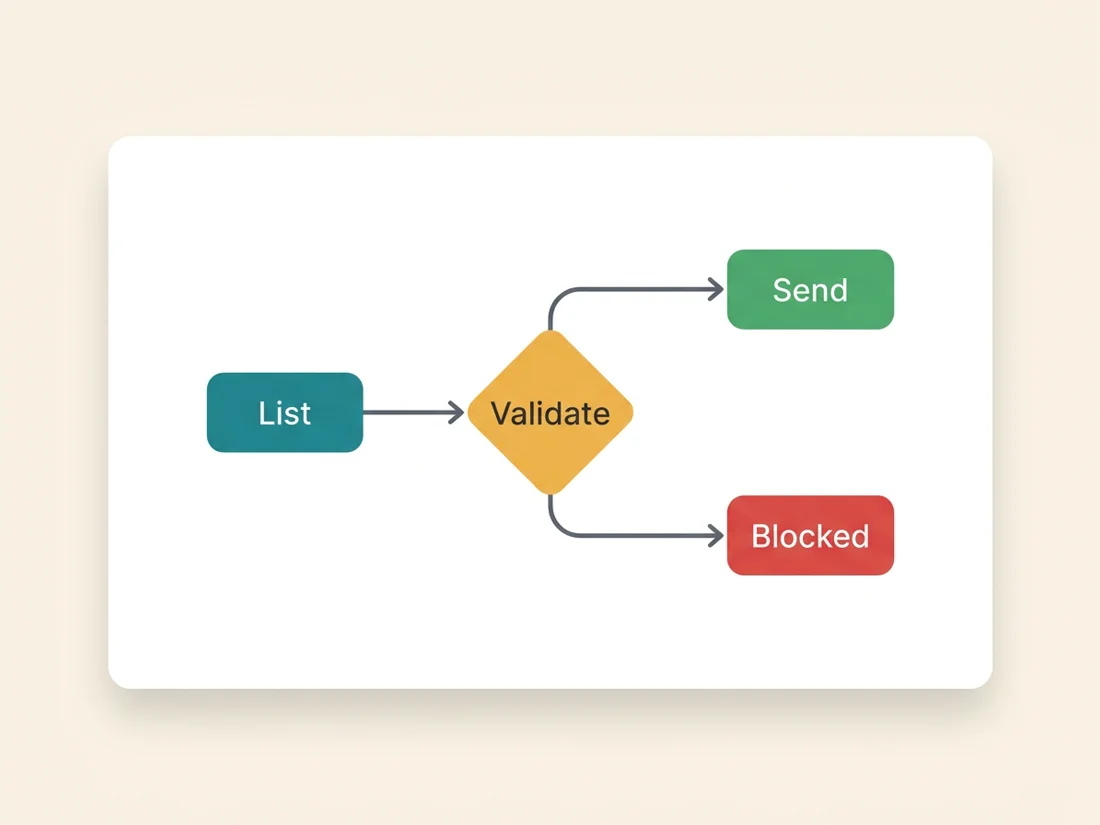
The durable fix is not a quarterly cleanup, it is architecture: put the data-quality machinery in the automation's path so the sequence engine physically cannot run on garbage.
- Validate at every entry point. Real-time checks on forms and imports, full validation before any list touches a sequence. In SpamCipher, Email Validation is the gate in front of the Flows engine: invalid addresses are removed and risky ones held before a single step schedules.
- Make segments self-maintaining. Instead of static lists, define segments as living rules that re-evaluate as data changes, so membership stays true without anyone remembering to refresh it. That is exactly what Living Segments are for, and they are the difference between branching logic that reflects reality and branching logic that reflects January.
- Give every merge field a fallback. Audit your templates so no {{field}} can render empty or wrong; a sentence that works without the variable beats a variable that might be false.
- Wire the feedback loop to the brakes. Bounces and complaints from any step should suppress the contact everywhere and, past a threshold, slow the machine itself. SpamCipher's abuse monitor does this automatically: throttle, then pause, before a data problem becomes a reputation problem.
Build it this way and automation finally delivers what the demo promised, because every message it sends goes to a real person, addressed correctly, in a segment that still means something. That is the standard behind the four promises we open with: SpamCipher is the cold email platform, unlimited email sending, automated cold email, and the only platform that can promise you 90%+ inbox placement. The promise is not that our sequences are cleverer; it is that our sequences are never allowed to run on data that would break them. Clean the data, then automate; the order is the whole trick.
Automate on data that deserves it
Validation gates every list, Living Segments keep audiences fresh, and the abuse monitor brakes before trouble. Unlimited, automated cold email on the pipeline built for 90%+ inbox placement.
Build your first Flow