
Your prospects have read thousands of machine-written messages by now, and they have built the same reflex you have: spot the pattern, hit delete. Learning to write emails that don't sound like AI has quietly become a core outreach skill, and the answer is not abandoning the tools; it is knowing exactly what the tools are bad at and doing that part yourself. This guide names the tells that get AI-flavored email deleted in two seconds, explains why the problem shows up in your deliverability numbers before it shows up in your replies, and gives you the six-step workflow that keeps the drafting speed while restoring the voice. We are SpamCipher, the cold email platform built for unlimited email sending and automated cold email, and the only platform that can promise you 90%+ inbox placement; we automate almost everything about sending, which is exactly why we are picky about the one thing that should stay human.
Why emails that don't sound like AI win the inbox in 2026
The economics of email flipped when drafting became free. When writing a message cost someone ten minutes, receiving one carried a weak signal that a human spent ten minutes on you. Now that a plausible email costs nothing to produce, readers price that in: polish is no longer evidence of effort, and a certain kind of polish has become evidence of its absence. The scarce signal moved. What cannot be mass-produced is specific knowledge of the reader (the fact only someone who looked would know) and a voice with actual texture, so those are what readers now scan for before granting the second sentence.
This is not speculation about the future; it is observable in reply behavior today. Sequences that lean on generated personalization ("I was impressed by your recent achievements at Acme") perform worse each quarter as recipients' pattern libraries grow, while short, flat, specific messages hold their reply rates. The audiences most saturated with outreach (founders, executives, sales leaders) developed the reflex first, and the sensitivity is spreading down-market on the same curve every spam pattern does. Writing like a human is no longer a nicety, it is differentiation, and it compounds precisely because most senders will not do the work this article describes.
The tells: how readers spot machine writing in two seconds
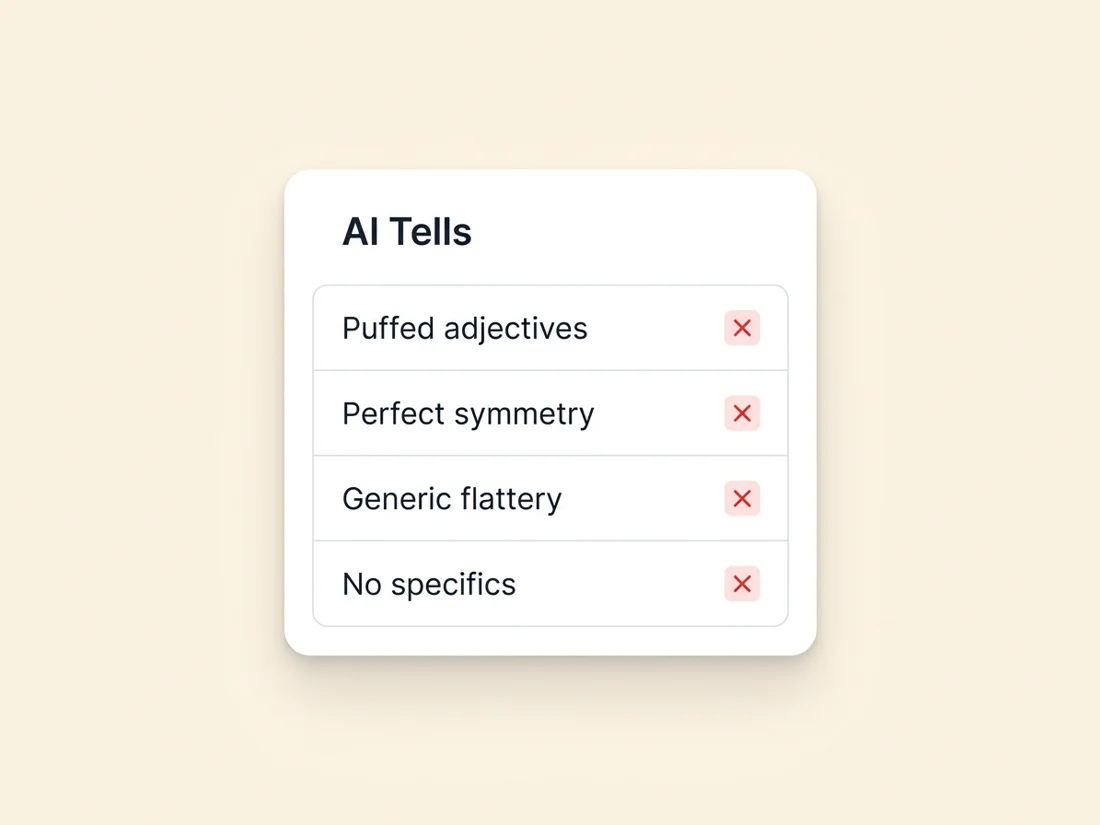
Readers do not run detectors; they pattern-match, and the patterns are consistent enough to list. Audit your own outbound against these five.
- Puffed adjectives doing no work. "Incredible journey", "game-changing solution", "truly impressive growth": superlatives attached to nothing specific are the single loudest tell, because models reach for intensity where humans would reach for a fact.
- Perfect symmetry. Three balanced clauses, a tidy antithesis, every paragraph the same length, the epigrammatic closer that lands a little too neatly. Human email is rhythmically lumpy: a two-word sentence, then a long one, then a fragment. Prose with no lumps reads as manufactured.
- Generic flattery wearing a merge field. "I love what you're doing at {{company}}" is the modern "Dear Sir or Madam". If the compliment survives swapping in any other company's name, it is not personalization, it is upholstery.
- No falsifiable specifics. Machine drafts describe categories ("companies like yours face challenges scaling outreach") because the model does not know your reader. A human who looked knows the thing: the product launched Tuesday, the six new sales hires, the podcast quote. One checkable fact outweighs three paragraphs of plausible generality.
- The hedge-everything register. "I understand you may be busy, but if it is not too much trouble, perhaps..." Models are trained toward inoffensiveness; humans with a real reason to write say the thing. Excessive courtesy padding signals that nobody in particular is talking.
The tells start before the open, too. Generated subject lines cluster around recognizable shapes: Title Case With Every Word Capitalized, the colon construction ("Unlock Growth: 5 Strategies for Scaling Outreach"), and benefit claims compressed into headline grammar. A human writing to one person types something small and lowercase, which is why the subject line conventions that win cold outreach (two to five plain words naming something the reader owns) double as AI-tell repellent: they are simply hard shapes for template thinking to produce.
Notice what is absent from this list: contractions, personal pronouns, or any single word you could ban. The tell is never one token; it is the statistical smell of text optimized to be acceptable to everyone, and the fix is correspondingly structural, not lexical.
Why this is a deliverability problem, not a style debate
If AI-flavored writing only cost you replies, it would be a copy problem. It costs more than that, through two mechanical loops.
First, the engagement loop. Mailbox providers rank your future mail partly on how recipients treated your past mail, and machine-flavored messages generate the worst engagement profile there is: deletes without reading, ignores, and the occasional irritated spam report from someone who resents being templated at. That profile suppresses placement for everything you send next, including the good messages; the mechanics are the same ones covered in our reply-rate benchmarks, where the upstream fix is always placement and the placement is always downstream of engagement.
Second, the volume loop. Because generated mail is free to produce, teams that adopt it tend to send more of it to broader lists with less qualification, and every deliverability failure mode scales with that decision: complaint rates climb toward the 0.3% ceiling, spam-trap odds rise with list breadth, and the sending domain accumulates the reputation of its worst campaign. The writing style and the volume habit arrive together, and providers punish the pair. This is also why the fix cannot be purely stylistic: a beautifully humanized message sprayed at ten thousand unqualified addresses still fails, which is why everything in this piece assumes the pipeline discipline (verified lists, warmed domains, throttled sending, measured placement) underneath it.
The positive version of the fix deserves stating plainly, because "don't sound like AI" can read as pure prohibition. The register that works is flat: short declarative sentences, concrete nouns, numbers instead of adjectives, and no performance. Flat writing is not dumbed-down writing; it is writing with nothing between the reader and the point. It also happens to be the register busy professionals use with each other, which is why it passes the two-second triage that polished prose fails. Aim for the email a competent colleague would send, not the one a copywriter would.
The right division of labor between you and the model
The honest position is neither "never use AI" nor "let it write everything". Models are genuinely excellent at parts of this job and reliably bad at others, and the craft is routing each part to the right worker.
Give the model: research compression (summarize this 10-K, these three blog posts, this changelog into five bullets), structural drafting (give me a skeleton for a three-touch sequence about X), variant generation for testing, tightening (cut this to 90 words), and consistency checks (does this contradict the earlier email?). In all of these the model works from material you gave it, and its output faces you, not the prospect.
Keep for yourself: the one specific observation that justifies the email existing (the model cannot know what only looking reveals), the voice (yours has texture no instruction fully transfers), the claim check (never let a draft assert a fact you did not verify, because a confident hallucinated detail is the fastest possible credibility death), and the judgment call of whether this person should receive this message at all. The division runs on one principle: the model drafts, you decide and you sign. Anything the reader will experience as "a person noticed me" must actually come from a person, or the whole message becomes a small lie that the reader is increasingly equipped to detect.
How to write emails that don't sound like AI: the six-step workflow
Here is the repeatable version, tuned for outreach but applicable to any email that matters. It adds roughly three minutes per message over raw generation, which is the entire price of not sounding like a robot.
- Step 1: draft with real inputs. Feed the model your actual research (their launch, their words, your relevant proof point), not just a persona. A draft grounded in specifics starts halfway human; a draft from "write a cold email to a VP of Sales" starts unrescuable.
- Step 2: strip the adjectives. Delete every intensifier and evaluative adjective that is not attached to evidence. "Impressive growth" dies; "grew the team from 4 to 11 since March" lives. This single pass removes most of tell number one.
- Step 3: insert one verifiable specific. Somewhere in the first two sentences, place the fact that proves a human looked: the thing they shipped, said, or changed, stated plainly. This is the load-bearing sentence of the whole message and the one the model cannot write for you.
- Step 4: break the rhythm. Read the draft's shape: if every sentence is the same length and every paragraph balances, rough it up. Shorten one sentence to three words. Let one run long. Delete the tidy concluding aphorism entirely; human emails just stop.
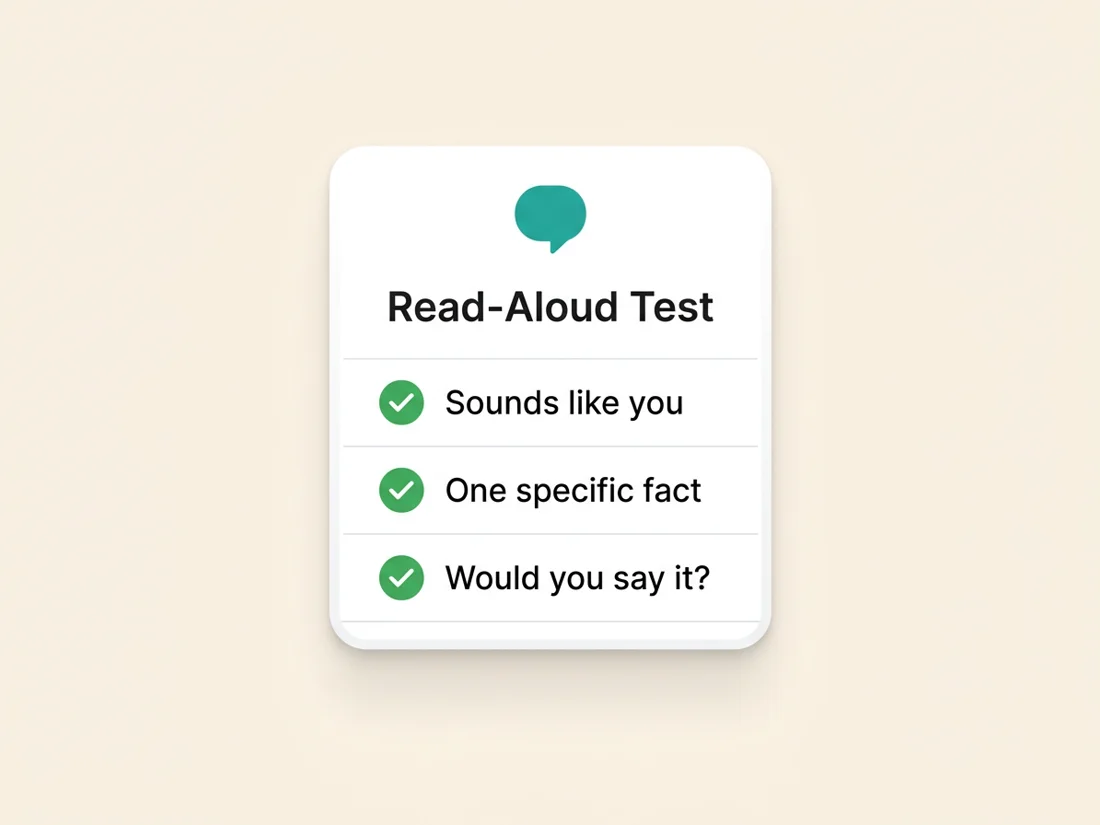
- Step 5: the read-aloud test. Say it out loud. Anything you would not say to this person across a table gets rewritten in the words you would actually use. This test catches the hedge-padding, the formality drift, and the phrases that exist only in writing.
- Step 6: cut 30%. Whatever survives, cut it by nearly a third. Generated drafts pad structurally, and the discipline of the cut forces every remaining sentence to earn its place. For cold outreach the ceiling stays where our sales email guide puts it: under 120 words, one ask.
The workflow applied. Raw draft: "Hi Jane, I hope this email finds you well! I came across Acme and was truly impressed by your incredible journey in the logistics space. Companies like yours are constantly facing challenges when it comes to scaling their outreach efforts effectively. Our cutting-edge platform empowers teams to unlock their full potential..." After the six steps: "Hi Jane, saw Acme opened the Rotterdam hub last week. Teams usually hit customs-doc chaos about a month after a launch like that; two other logistics ops leads fixed it with one workflow change. Worth a look?" The first version is fluent, symmetrical, and dead on arrival. The second is shorter, lumpier, contains one checkable fact, and could only have been written by someone who looked. That difference is the entire subject of this article, and it took three minutes.
Two additions make the workflow stick over time. First, build a voice file: collect five to ten emails you wrote naturally that got replies, and feed them to the model as the style reference in every drafting prompt. It will not fully capture your voice, but it starts drafts much closer to it, which shrinks steps two through five. Second, watch the team convergence trap: when a whole SDR team drafts from the same shared prompt, every rep's mail converges on one voice, and prospects who receive two of them see the template instantly. Shared prompts should carry the research standards and the structural rules; the voice file stays individual, because that is the part that is supposed to differ.
Where AI genuinely belongs in your email operation
Everything above concerns the message a prospect reads under your name. Around that message sits an operation where AI is not merely acceptable but clearly superior, and pretending otherwise would be its own dishonesty.
- Reply classification and triage. Sorting inbound replies (interested, referral, not-now, unsubscribe, objection) and routing each to the right next action is pattern work at volume, and machines do it faster and more consistently than tired humans. Our Reply Agent is exactly this: it reads intent, sets status, and notifies you inside hard guardrails, and it never impersonates you to write the substantive reply.
- Research assembly. Compressing a prospect's public footprint into a briefing you read before writing step 3's specific. The model gathers; you select.
- Segment and campaign analytics. Spotting the cohort whose engagement is sliding, the sequence step where replies die, the acquisition source producing silence. Machines find the pattern; you decide the response.
- Subject and variant testing. Generating candidate subject lines to test is cheap and harmless, because the test, not the model, picks the winner.
The through-line: AI belongs everywhere in the operation except the moment of pretending to be you. Use it there and you are spending your scarcest asset (the reader's belief that a person is talking) to save your cheapest one (drafting minutes). Every other use is leverage. And underneath both halves sits the layer no writing choice can substitute for: the mail has to arrive. Verified lists, warmed domains, authentication at enforcement, throttled risk, and placement measured with real seeds are what make any voice audible in the first place, and that stack is precisely what SpamCipher is: the cold email platform for unlimited, automated cold email, and the only platform that can promise you 90%+ inbox placement. Let the machines run the pipeline and the triage; keep the two sentences that sound like you. That split wins on every metric that matters, and it is the only version of AI-assisted email your prospects will thank you for.
Automate the pipeline, not the personality
Verified lists, warmed domains, guardrailed reply triage, and placement you can measure, so the human sentences you write actually get read. Unlimited, automated cold email with 90%+ inbox placement.
Send emails that land