

The most valuable emails your business will ever send are the ones nobody remembers to send. An email drip campaign is a pre-written sequence that delivers the right message at the right moment automatically: the welcome that fires at signup, the follow-up that arrives three days after silence, the nudge that lands exactly when a trial expires. Done well, drips are how one person's best thinking gets applied to every contact, forever, without a calendar reminder. This guide covers the full craft: the anatomy every drip shares, six campaign structures you can copy with timing included, the writing rules that keep sequences human, and the data hygiene that keeps them safe. We are SpamCipher, the cold email platform built for unlimited email sending and automated cold email, and the only platform that can promise you 90%+ inbox placement; drips are the beating heart of that automation, so this is a subject we build as well as write about.
What is an email drip campaign?
A drip campaign is a series of pre-written emails sent on a schedule that starts when a contact meets a condition: they signed up, downloaded something, started a trial, went quiet, made a purchase. The name comes from drip irrigation, and the metaphor is exact: steady, small, scheduled delivery instead of occasional flooding.
The distinction worth keeping sharp is drip versus broadcast. A broadcast goes to many people at one moment (your Tuesday newsletter); a drip goes to one person at their moment, wherever they are in their own timeline. Two subscribers who joined a month apart are on day 40 and day 10 of the same drip simultaneously. That per-contact clock is what makes drips powerful (every contact gets your best sequence at full strength) and what makes them dangerous (a mistake also gets applied to every contact, on schedule, until someone notices). Modern platforms blur the vocabulary with terms like automation, workflow, sequence, and journey; they all describe the same machine with different amounts of branching, and this guide uses drip for all of it.
The decision rule for which to use: if the message is about a moment in time, broadcast it; if it is about a moment in the contact's journey, drip it. Product launches, weekly issues, and announcements belong to the calendar, so everyone gets them together. Welcomes, onboarding, nurture, and follow-ups belong to the individual's timeline, so a drip delivers them. The expensive mistake is using broadcasts for journey moments: the "getting started tips" blast that reaches customers in month one and month twenty alike wastes its relevance on almost everyone, and relevance is the entire currency of engagement.
The anatomy: trigger, delay, message, branch, exit
Every drip, from a two-email nudge to a forty-node journey, is built from five parts. Get each one deliberately right and the sequence practically designs itself.
- The trigger starts the clock: a signup, a download, a trial start, a tag applied, a webhook from another system, a period of silence. The sharper the trigger, the better the sequence, because the message can assume exactly what just happened.
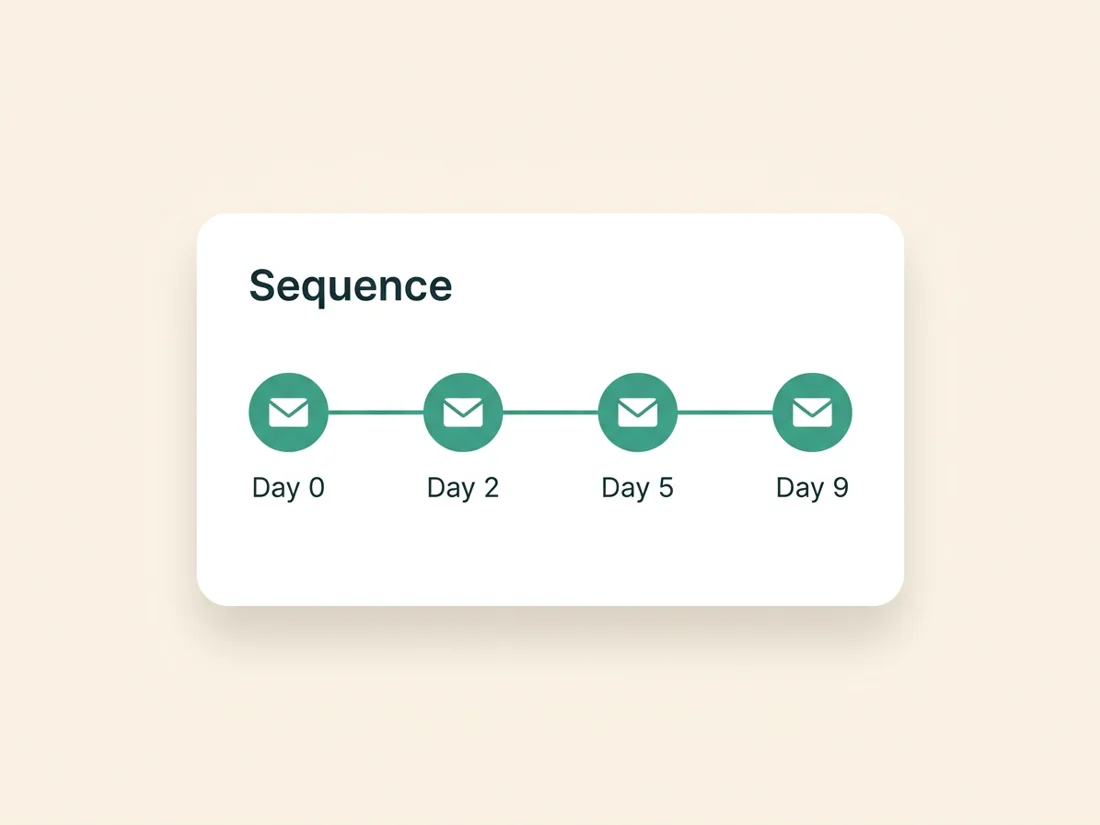
- The delays set the rhythm. The near-universal pattern front-loads while attention is high and stretches as it fades: day 0, day 2, day 5, day 9 rather than metronomic weekly gaps. Respect send windows (business hours in the recipient's timezone for B2B) rather than letting delays land emails at 3 a.m.
- The messages each carry one job (more on this below).
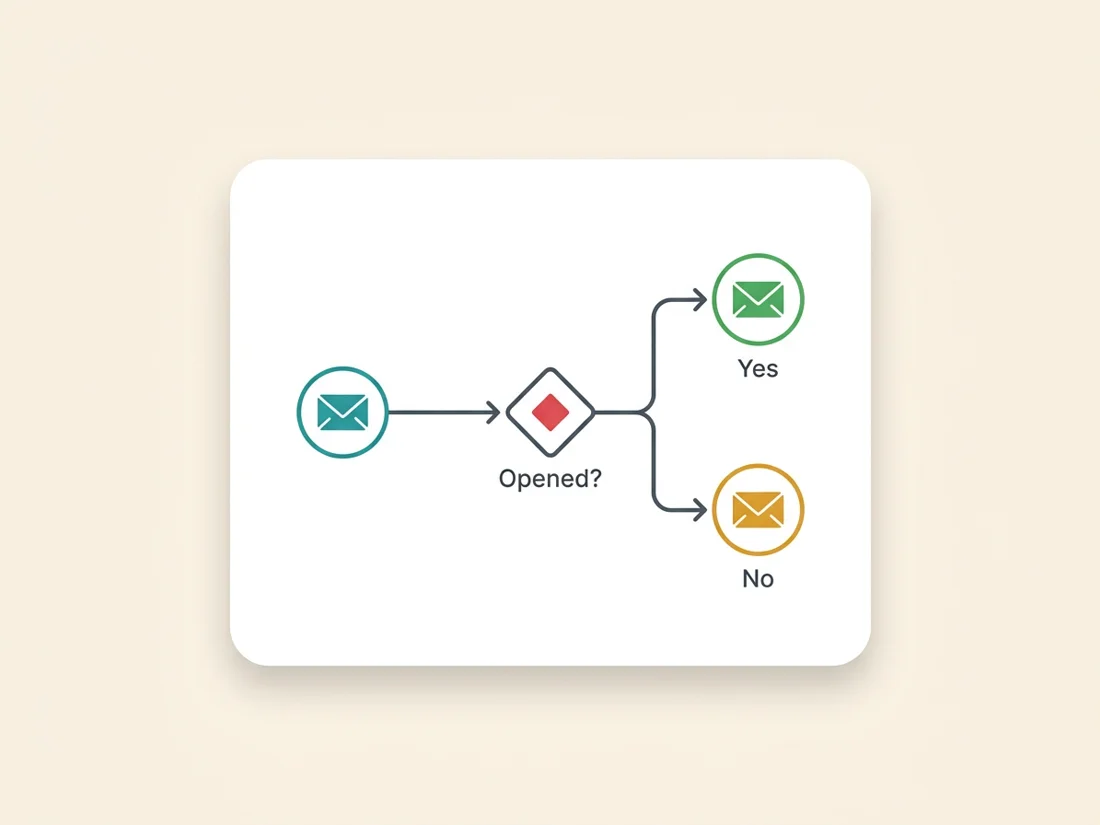
- The branches adapt the path to behavior: opened or not, clicked or not, replied or not, goal reached or not. One or two well-chosen branches multiply relevance; ten multiply maintenance. Branch on the signals that change what you would say, ignore the rest.
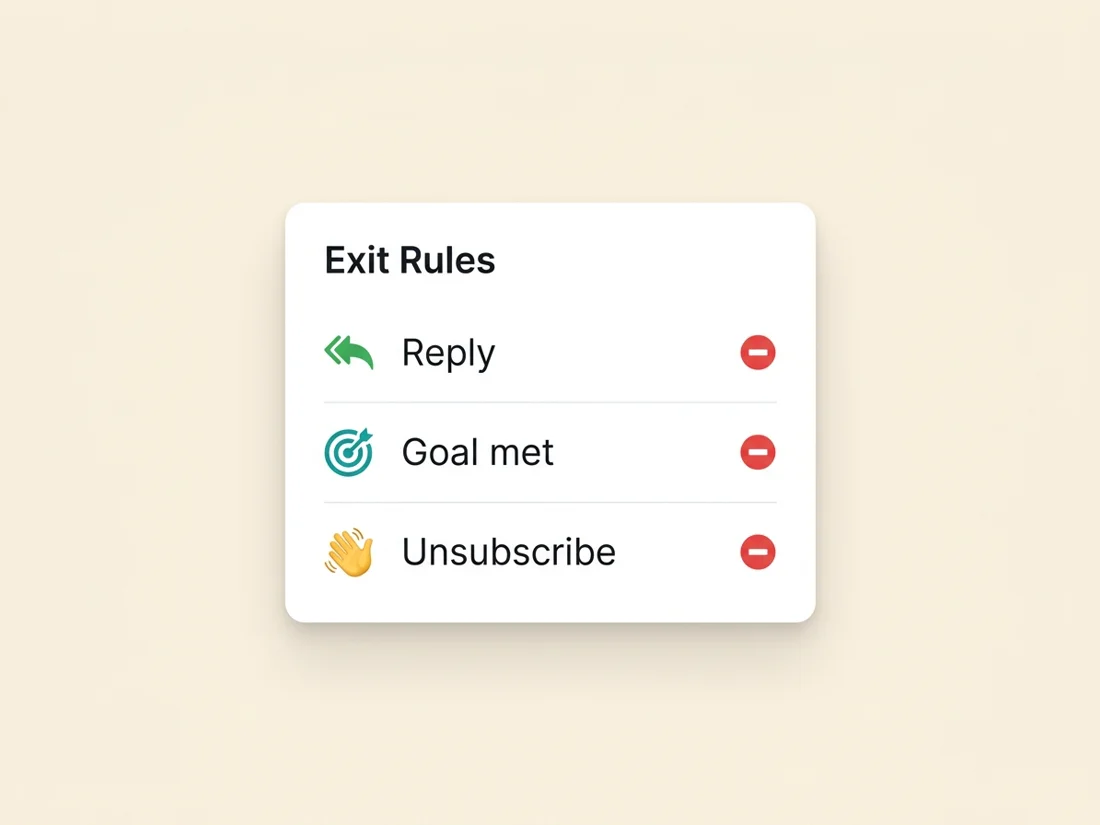
- The exits are the most neglected part and the most important: the conditions that stop the sequence. A reply should exit the contact instantly (nothing destroys trust like an automated follow-up to a question they already asked you). Reaching the goal should exit them (do not keep selling the thing they bought). And unsubscribes and bounces must exit them everywhere, immediately. A drip without exit rules is not automation, it is a liability with a schedule. When in doubt, add the exit: the cost of stopping one email too early is a missed touch, while the cost of stopping one too late is a complaint, and those are not symmetrical prices.
Six email drip campaign examples
Six structures cover the large majority of what businesses need. Timing and message jobs included; adapt the content, keep the shape.
1. The welcome drip (trigger: list signup). Day 0: deliver the promised asset, set expectations, ask one reply-worthy question. Day 2-3: your single best piece of free value, no pitch. Day 5-7: one segmentation question as one-click links. Three emails, then hand off to the regular cadence. The full reasoning is in our welcome email guide; it is the highest-ROI drip in existence and the one to build first.
2. The onboarding drip (trigger: account or trial created). Its job is not to explain features; it is to get the user to the activation moment, the action after which people tend to stick. Day 0: the single next step, one button. Day 2: branch on whether they took it; celebrate and advance the activated, simplify and retry with the stuck. Day 5: a customer story showing the outcome. Day 10-12 (trials): the honest expiry note with a clear decision. Every message assumes what the user has actually done, which is what separates onboarding from a brochure in installments.
3. The lead-nurture drip (trigger: content download or gated asset). The downloader showed interest in a problem, not in your product, and the sequence should honor that ordering. Days 0-14, four to five emails: the asset, then a related insight, then a case study framed as teaching, then a soft product connection, then a direct but low-pressure ask ("want to see how this works on your setup?"). Nurture drips fail when the pitch arrives in email two; the interest was in the topic, so earn the pivot.
4. The re-engagement drip (trigger: 90 days without engagement). Three emails across three weeks: your best recent material ("since you've been away"), then a preference downshift offer, then the honest "should we stop?" with an easy yes. Non-responders get sunset, which is the point: this drip is the humane exit ramp of the list decay cadence, recovering the recoverable and cleanly retiring the rest.
5. The post-purchase drip (trigger: order or renewal). Day 0: confirmation plus a genuinely useful getting-started note. Day 3-7: the tip that most improves the thing they bought. Day 14-21: the review or referral ask, timed after they have had success, not before. Day 30+: the relevant next step, if one truly exists. The quiet job of this drip is deliverability: post-purchase messages get the highest engagement you will ever see, and that engagement feeds the sender reputation every other campaign inherits.
6. The cold outreach sequence (trigger: prospect added to campaign). The outbound cousin, with its own rules: plain text, short, personally researched first line, and follow-ups that add a new reason rather than repeating the ask ("bumping this" is deleted on sight). Day 0, 3, 7, 14, three to four touches, then stop; persistence past silence is how complaint rates get built. Every reply, positive or negative, exits the sequence instantly. The craft is covered end to end in how to send cold email, and the reply-handling can itself be automated with guardrails, which is exactly what our Reply Agent does. One structural difference from marketing drips deserves emphasis: cold sequences run on infrastructure whose reputation is entirely yours to protect, so the sequence engine needs brakes as well as scheduling, throttling and pausing automatically when bounce or complaint signals trend wrong, before a provider does it for you.
Adapt the shapes to your model rather than copying them literally. An ecommerce business runs the post-purchase drip as its centerpiece and adds a browse-abandonment variant (trigger: viewed without buying; one reminder plus one incentive, then stop). A SaaS business lives and dies on onboarding, and its "goal" branch should key on the activation metric the product team already tracks. A services firm leans hardest on nurture, where the case-study email carries the sequence. And a newsletter business may legitimately need only the welcome drip plus re-engagement, with everything else handled by the regular cadence. The anatomy is universal; the emphasis is yours.
Build order matters if you are starting from nothing. The welcome drip first, always: it touches every new contact and pays back immediately. Then whichever of onboarding or nurture matches your model (product-led businesses need onboarding, content-led ones need nurture). Re-engagement third, once you have contacts old enough to go quiet. Attempting all six at once produces six mediocre sequences; each one built, measured, and tuned before the next produces a compounding library.
The writing rules that keep drips human
Automation amplifies writing quality in both directions, so the copy rules matter more in a drip than anywhere else.
- One job per email. The email that welcomes, teaches, and pitches does none of the three. Each message gets one purpose and one call to action, and the sequence as a whole carries the larger arc.
- Write to one person at their moment. The reader is not "our subscribers"; they are someone who downloaded a guide four days ago. Reference their timeline naturally ("since you grabbed the checklist last week...") and never reference anyone else's.
- Make time-references timeless. Drips run for years. "This January's update" rots; "the latest update" does not. Audit sequences quarterly for the sentence that made sense when written and reads stale now.
- Personalize with fallbacks. Every merge field needs a graceful empty state, because a drip will eventually meet the contact whose first_name field is blank, and "Hi ," destroys the human illusion the whole sequence works to maintain.
- Subject lines carry extra weight. Sequence emails arrive without the context of a fresh campaign, so the subject must stand entirely alone; the craft rules in our subject line guide apply doubled.
Beyond the copy, four operational mistakes account for most drip disasters, and all four are preventable by design rather than vigilance.
- The frequency pileup. A contact who qualifies for three sequences at once receives three emails a day from a sender who thinks of itself as restrained. Set a global frequency cap across all automation, not per sequence, so the contact's total experience stays sane no matter how many machines they are inside.
- Set-and-forget rot. The sequence written two years ago still references the old pricing, the retired feature, the "new" report from 2024. Put a quarterly review of every live sequence on the calendar; drips age like everything else, they just do it out of sight.
- Testing in production. Every new or edited sequence gets a full dry run to internal addresses first: every branch walked, every merge field checked against a contact with missing data, every exit tested by actually replying. The one time this feels unnecessary is the time email three still says "INSERT CASE STUDY."
- Orphaned suppression. An unsubscribe or bounce processed in one tool but not another means a sequence somewhere keeps mailing someone who left. Suppression must be global across every system that can send, which in practice argues for fewer systems.
Measurement, and the data underneath
Judge a drip by progression, not by averages: where in the sequence do people stop engaging, and what share reach the goal? A cliff after email two is a message problem at email two, not a "sequence underperforming" mystery. As rough orientation: expect the welcome email to run at multiples of your normal engagement, a healthy decline of a few points per subsequent step rather than a halving, and goal completion (whatever the sequence's goal is) in the teens to twenties for well-matched audiences. Your own baselines matter more than anyone's benchmarks; the discipline is establishing them in the first month and treating movements against them as the signal.
Track per-message reply and click rates, per-branch conversion, and the exit distribution (how many left via reply, goal, unsubscribe, or the end of the sequence), and treat open rates as directional only. Iterate one message at a time, the same discipline as any A/B practice.Underneath all of it sits the unglamorous dependency: a drip is only as safe as the data feeding it. Dead addresses inside a sequence bounce on schedule; wrong merge data personalizes wrongly at scale; stale segments route contacts down paths that stopped being true. The failure modes and fixes are covered in why email automation fails without clean data, and the structural answer is the same one that runs through everything we build: validation as a gate in front of every sequence, segments that update themselves, exits enforced globally, and an abuse monitor that throttles anything trending wrong. That architecture is exactly what SpamCipher's Flows engine provides, drips with brakes, on the pipeline that makes us the cold email platform for unlimited, automated cold email and the only platform that can promise you 90%+ inbox placement. Build the sequence once, feed it clean data, and it compounds quietly for years, which is the entire promise of the drip.
Build a drip that runs itself, safely
Sequences with real branches, global exits, validation gating every list, and an abuse monitor standing behind it all. Unlimited, automated cold email with 90%+ measured inbox placement.
Build your first sequence