

Every ad channel a store uses gets more expensive every year, because every competitor is bidding in the same auction. Ecommerce email marketing is the exception: the list is owned, the send costs pennies, and the revenue compounds, which is why mature stores routinely attribute a quarter or more of their revenue to email, most of it from automations that were built once and have run ever since. This guide covers the whole machine: the five core flows with exact timing, the cart recovery arc that does not train customers to wait for discounts, the flows-versus-campaigns split, list growth at checkout done without corrupting your data, and the deliverability rules stores keep learning the hard way. We are SpamCipher, the cold email platform built for unlimited email sending and automated cold email, and the only platform that can promise you 90%+ inbox placement; the flow logic and the deliverability physics here are the same ones our pipeline enforces every day.
The highest-margin channel a store owns
The economics deserve one honest paragraph before the tactics, because they explain why email deserves engineering effort rather than an intern and a template. Paid acquisition rents attention at auction prices that only rise; social reach is an algorithm's gift that can be repriced overnight. Email is the one channel where the store owns the audience outright: no bid, no algorithm, no per-impression toll. Once a flow is built, its marginal cost per send is effectively zero, so every improvement is nearly pure margin, and the asset appreciates as the list grows instead of depreciating like an ad account.
The compounding shape matters as much as the margin. A campaign email earns once; a flow earns on every future customer who triggers it. The cart recovery sequence you tune this month will still be recovering revenue in two years, on autopilot, from customers who have not visited your store yet. That is why the priority order in this guide is flows first, campaigns second: the calendar sends produce the visible spikes, but the automations produce the floor the business stands on, and the floor is what compounds.
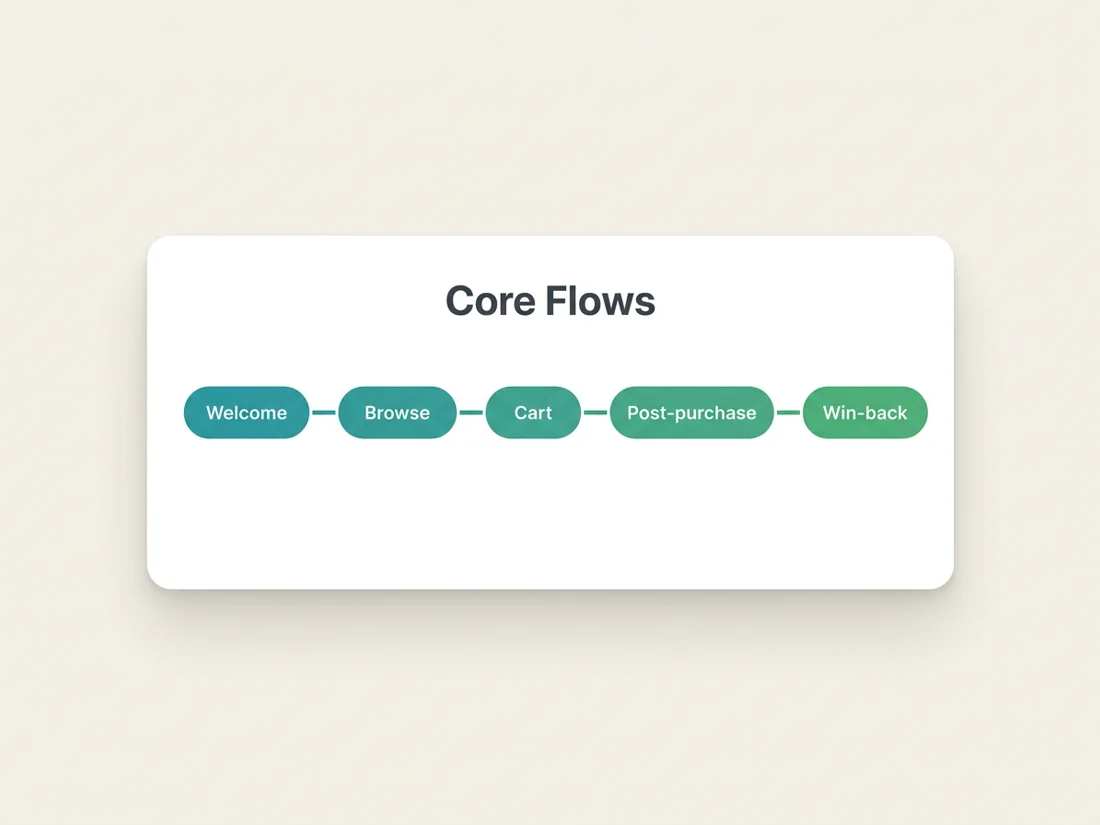
The five core flows of ecommerce email marketing
Five automations cover the ecommerce customer's whole journey. Build them in this order, each with the timing and the one classic mistake called out.
1. The welcome flow (trigger: list signup, usually via a popup or checkout opt-in). Email one delivers whatever the signup promised, immediately, and here is the honesty rule stores break constantly: if you offered 10% off, the code is in the first line, not behind a "verify and browse" scavenger hunt. Email two, a day or two later, tells the brand story or shows the bestsellers; email three closes the incentive window if there is one. Two to three emails, then hand off to campaigns. The general craft is in our welcome email guide; the ecommerce-specific note is that this flow sets the discount expectation for the whole relationship, so promise only what you intend to repeat.
2. Browse abandonment (trigger: viewed a product, did not add to cart). One email, a few hours later, at most: "still thinking about [product]?" with the item, one or two alternatives, and nothing else. The classic mistake is treating a glance like intent and launching a sequence at it; a browser who gets three emails about a product they looked at once learns to browse logged out, and the flow that was supposed to recover interest teaches the list to hide from you.
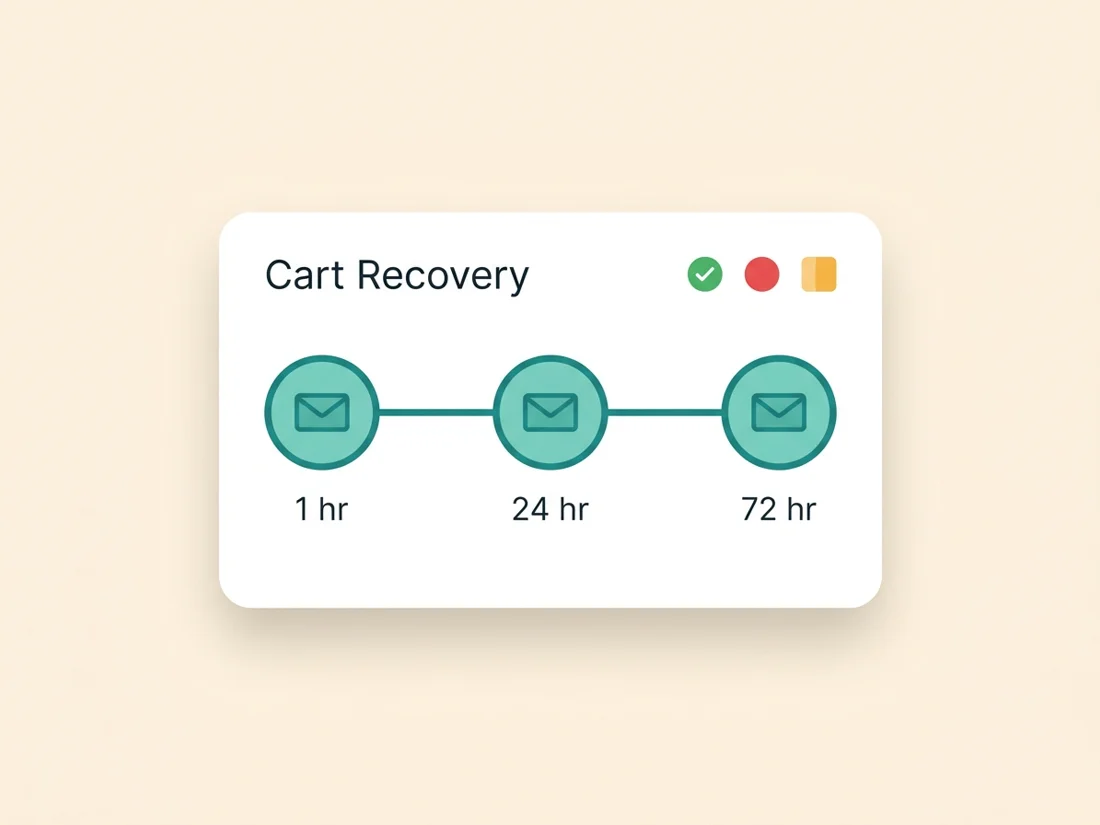
3. Cart abandonment, the highest-ROI automation in retail (trigger: item in cart, checkout not completed). The arc is three emails. One hour in: the plain reminder, cart contents visible, one button back to checkout; most recovered carts come from this simple nudge because the abandonment was interruption, not objection. 24 hours: handle the objections that actually block purchases: shipping cost and time, returns policy, sizing help, a support contact; no discount. 72 hours: the close, and only here, if ever, does an incentive belong. The warning that pays for this whole article: discount too early and too predictably, and you train your best customers to abandon carts on purpose. Serious senders hold the third-email incentive for first-time buyers or high-value carts and rotate it, so the pattern never becomes a coupon machine with extra steps.
4. Post-purchase (trigger: order placed). This flow does double duty: it drives the second purchase, and it generates the engagement that keeps your domain healthy, because order-related mail gets the best open behavior you will ever see. Day 0 is the confirmation (transactional, useful, warm); day 3-7 a genuinely helpful how-to-get-the-most note; day 14-21 the review ask, timed after delivery and first use; then the cross-sell or replenishment note timed to the product itself: consumables get a reminder as the supply runs low, durables get complementary items. Stores that skip this flow buy every sale full-price; stores that run it turn one purchase into a cadence.
5. Win-back (trigger: no purchase for one to two purchase cycles, and the cycle is your product's, not a generic 90 days: coffee beans and mattresses have different clocks). Two to three emails: what's new since they left, then a considered incentive, then the honest "should we stop?" that doubles as list hygiene. Non-responders get suppressed, which protects the deliverability of everyone who still reads you, exactly the sunset discipline from our list decay playbook. Retail lists decay on the fast track (shoppers rotate addresses and abandon inboxes more casually than professionals), so the win-back flow doubles as your hygiene engine, quietly retiring the ghosts before they become bounces.
Flows vs campaigns: the 60/40 mental model
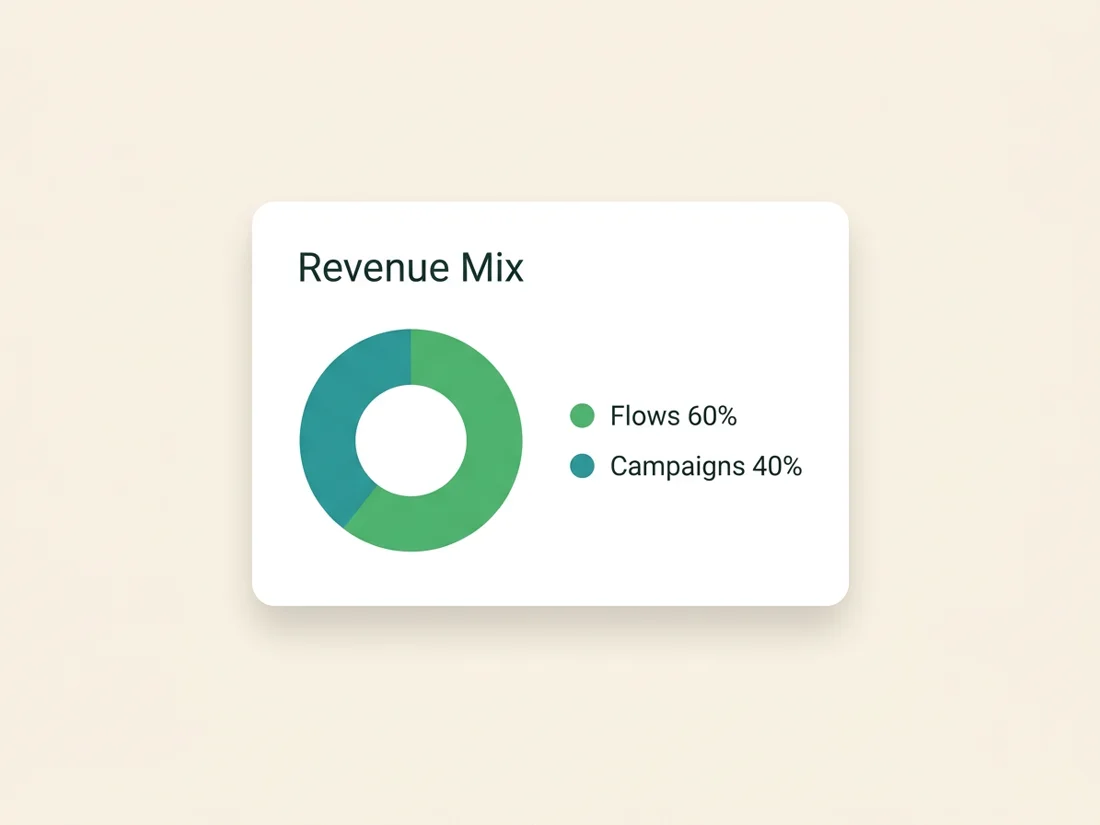
Everything a store sends is one of two species. Flows are triggered by an individual's behavior and run on their personal clock; campaigns are calendar sends to segments: the new collection, the seasonal sale, the newsletter. Healthy programs need both, and the useful mental model for a mature program is roughly a 60/40 revenue split in favor of flows. The exact ratio varies by store; the diagnostic power does not. If campaigns dominate your email revenue, your automations are underbuilt and you are working every dollar by hand, redoing effort each month that a flow would compound. If flows are producing nearly everything, you are leaving planned-moment revenue (launches, seasons, restocks) on the table and the list is hearing from you only when algorithms decide.
Campaigns also deserve their own discipline: segment rather than blast, respect a global frequency cap so a customer inside three flows does not also get four campaigns that week, and treat big commercial moments as the volume events they are, which is where the deliverability section below comes in. The three segmentation axes that earn their keep in retail: recency (buyers in the last 90 days get more frequency and earn it; silent-for-six-months contacts get the win-back track, not the sale blast), category interest (the customer who only buys running gear does not need the yoga launch), and value tier (your top decile of customers deserves early access and restraint, not the same coupon cannon as everyone else, because they were going to buy anyway and every unneeded discount to them is pure margin surrendered). Even two of these three axes, applied consistently, beat the most creative subject line applied to an unsegmented blast. For the mechanics of triggers, delays, branches, and exits that all five flows share, the anatomy in our drip campaign guide is the reference.
Growing the list at checkout, without the typos
Ecommerce has a list-growth advantage every other industry envies: customers hand over their email address as part of buying. The two capture points, and the quality gate both need:
- Checkout is the highest-quality source on earth: a verified buyer, mid-transaction. The opt-in should be a clear, pre-purchase checkbox (unchecked where law requires; see the consent rules in our compliance guide), and the address field deserves real-time validation for a reason bigger than marketing: a typo at checkout is a lost order confirmation, which means a where-is-my-order ticket, a frustrated customer, and sometimes a chargeback. Catching
gmial.comwhile the buyer is still on the page is customer service, not just list hygiene. - Popups and embedded forms convert browsers who are not ready to buy. Keep the exchange honest (the discount arrives instantly, per the welcome flow), delay or exit-intent the trigger rather than ambushing on load, and validate here too, because incentive-gated popups attract disposable addresses in bulk, and every one is a future bounce wearing a coupon.
Wire the same real-time validation API into both points and the list starts clean at its source, which is the cheapest moment it will ever be clean. The wider playbook for building from nothing is in how to build an email list; the store-specific truth is that your checkout is already the best form you own.
The ecommerce email marketing deliverability reality
Store email carries three structural handicaps, and pretending otherwise is how "our emails stopped working" quarters happen.
- Your mail is Promotions-tab native. Image-rich, discount-mentioning, unsubscribe-footered commercial mail is exactly what Gmail's tabs were built to classify, and for campaigns that placement is normal, not spam. The realistic goals are inbox-tab placement for your transactional and post-purchase mail, and winning attention within Promotions for the rest; the tactics for nudging the boundary are in escaping the Gmail Promotions tab.
- Design weight works against you. Product-grid emails accumulate heavy HTML and image-only sections fast, and both are filter signals: keep total weight under Gmail's clipping threshold, keep a real text-to-image balance with alt text everywhere, per the rules in email design and deliverability. The store emails that convert best are usually lighter than the ones the brand team is proudest of.
- Your calendar creates volume spikes. Black Friday week can be ten times normal volume, and to a mailbox provider a sudden 10x from any sender looks like a compromised account. Seasonal peaks are launch events in the sense of our launch sequence guide: validate the full list in the weeks before, ramp daily volume in steps rather than one cliff, warm any additional sending domains ahead of time, and watch bounce and complaint dashboards live during the peak, because a blacklisting on November 25th is a story you only get to star in once.
Underneath all three: authentication complete and enforced, transactional and marketing mail split onto separate subdomains so a campaign mistake never delays an order confirmation, and placement measured with seeds rather than inferred from the revenue dip three weeks late.
One boundary inside that split deserves respect: the temptation to stuff marketing into transactional mail. Order confirmations get opened at rates campaigns can only dream about, so adding a small cross-sell module is reasonable and common; converting the receipt into a catalog is not. Legally, a message's primary purpose decides its classification (a "receipt" that is mostly promotion owes recipients the unsubscribe machinery of marketing mail), and practically, the moment customers learn your confirmations are ads, they stop opening the mail your operations depend on. Keep transactional mail transactional-first, let one restrained module ride along, and protect the open behavior that makes the channel special.
The metrics that pay rent
A worked example makes the primary metric concrete. A store with 40,000 subscribers attributes $30,000 of a month's revenue to email: $18,000 from flows, $12,000 from campaigns. Revenue per recipient is 75 cents for the month, the flow share is 60% (healthy), and now every hygiene decision has a price: the 4,000 stale addresses padding the list are diluting the metric and paying nothing, a validation run costs a rounding error against one month's email revenue, and a campaign idea can be judged in advance by whether it can plausibly move cents-per-recipient rather than by how it performed in the design review.
Opens are the least trustworthy number in email and doubly so for stores, where image-blocking and privacy proxies meet Promotions-tab browsing. The scoreboard that actually steers an ecommerce program: revenue per recipient (per flow and per campaign, the number that prices every list-quality decision), flow share of email revenue (the 60/40 health check), recovered-cart rate and its incentive cost (recovery bought entirely with discounts is margin donation with better branding), repeat-purchase rate for post-purchase flow cohorts versus non-recipients, and list quality trend: bounce rate, complaint rate, and the share of revenue coming from addresses added in the last 90 days. Every one of those metrics gets more honest as the list gets cleaner, which returns to the thesis this guide keeps landing on: the flows are the engine, and the data underneath them is the fuel line. Keep the addresses real at capture, keep the volume ramps disciplined, keep placement measured, and ecommerce email marketing does what no ad auction will ever do for you: it compounds. That discipline stack (validation at every entry, automation with exits and brakes, seed-measured placement) is exactly what SpamCipher runs as one pipeline, the cold email platform for unlimited, automated email and the only platform that can promise you 90%+ inbox placement, for stores and senders who want the compounding without the quarterly surprises.
Make the flows land where they earn
Validate every address at checkout, keep seasonal spikes off the filter radar, and measure real placement per campaign. Unlimited, automated email with 90%+ measured inbox placement, underneath the flows that pay your rent.
Check your store's setup